Showing posts with label 1960s. Show all posts

Tuesday, April 9, 2013

MY 7 OBSESSIONS WITH "MAD MEN"

http://images.hitfix.com/photos/2938636/mad-men-season-6-gallery_article_story_main.jpg

I’m one of those people who can’t get enough “Mad Men,” and after waiting almost a year for the show to come back with new episodes, Sunday night was a major event. Maybe it’s the focus on the 1960’s, the decade in which I grew up, and the uncanny social accuracy the creators achieve. The sets, the costumes, the drinks, the cigarettes, the music, the sexy overtones (more on that later!), but especially the mindset. How could our cultural status have appeared so sophisticated, but really have been so, so innocent? This new set of episodes appears to be set right around 1968, and if ever there was a year that altered the American psyche and the future of the society, it was that year. As one who is obsessed with the show, here are 10 objects of my obsession from the first new episode:

1. THE CHANGING ROLE OF WOMEN: Main character Peggy Olsen represents the antithesis of what women were supposed to be back then. Career-laser-focused, Peggy is in a new, more responsible advertising position, and true to form,her behavior is now mirroring the behavior of her male counterparts at her former ad agency. That’s what women thought they had to do back then, and well into the 1980s, actually. They believed they had to become men to make the unlikely climb up the corporate ladder. “Can you get me some coffee?” she barks from her office while working all night on New Year’s Eve and forcing her male subordinates to do the same.
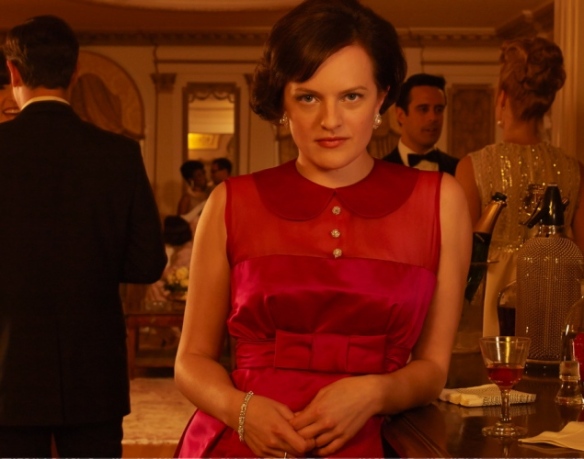
2. COUNTER CULTURE: A few seasons ago there was an NBC TV drama called “American Dreams,” also set in the 1960s, in which the year 1968 was just touched on in the third season. Those who didn’t live through the “hippie era” were about to see how it changed some young people from innocents into members of a new societal counter culture. It got cancelled. “Mad Men” is about to pick up right where “American Dreams” left off, with a view of how some young people rejected convention and formed their own youth movement.

 3. SEX: (As promised!) The birth control pill was only seven years old by 1968, and the HIV/AIDS scare was decades away, so sex was in the air, next door, in the office, at the holiday party, everywhere you can imagine. Back then, people blamed the more open attitude toward sex on the hippie movement, but truly it was a grownup phenomenon fueled by a widespread “because we can” attitude. Don Draper’s return to extra-marital flings in the first episode makes perfect sense. Comments now deemed inappropriate were de rigueur in the office back then. In the New Year’s Eve party scene in Don and Megan’s ultra-mod high rise apartment, a female guest who is in attendance with her husband, openly comes on to Don right in front of Megan. Later that same night, Don has sex with his neighbor’s wife. If only Sinatra were still with us to narrate that moment with his trademark “Ring-a-ding-ding.”

4. DEATH: Don Draper is focusing too often and too heavily on all things death-related. In one scene, a drunk Don questions the doorman at his apartment building, who had suffered a heart attack a while back and been declared clinically dead before being revived. “What did you see?” Don demands. “What was it like?” In another scene, Don plays the doorman’s death over again in his memory in slow motion. When Don attends a funeral gathering for co-worker Roger Sterling’s mother, he throws up in front of the entire crowd. In a rare faux pas, Don creates an ad campaign for a hotel/resort company that is rejected by the client, who says it strikes him as suggestive of suicide. Don’s got death on the brain.

 5. VICES: Cigarettes and booze are players in almost every scene in “Mad Men.” There is smoking in hospitals and at dinner tables, drinking at the office and even at funerals. When Roger Sterling’s secretary must inform him of his own mother’s death, he quickly pours her a stiff one, which she downs in one long gulp. On vacation in Hawaii, Megan Draper trudges down to a skeezy part of the beach to score a joint, which she victoriously brings back to the hotel room to smoke before she and Don have sex. Smoking pot was still considered sneaky, naughty, and yes…sexy. Very sixties.

6. MEN’S BURIED EMOTIONS: If you think men are denying their feelings orconcealing their emotions today, you really had to see 1960s men. Don Draper is great at withholding everything he feels and internalizing it all into some deep, dark tunnel of grey matter. And Roger Sterling, who barely blinked upon hearing of his mother’s death, cries wild tears upon hearing that his regular shoe shine man died – but only in his office, alone. 1960s men are accurately depicted in “Mad Men” as in emotional denial about everything and unable to converse with anyone in any circumstance about feelings.

 7.FASHION:“Mad Men” captures the look of the 1960s better than almost any fictionalized piece I have ever seen. In my first job out of college (1975) I worked at a TV station in which we absolutely had a woman of the Joan Holloway genre. Full figured, proud of it, and dressed to accentuate all of it. The office attire is dressy, tailored and dry-cleaned within an inch of its fibrous life. Men’s fashion is stylized, but understated. But, as mentioned, it’s 1968, and I predict soon we’ll see the leisure suits, chains, miniskirts, platform shoes, etc. But by 1968, office attire was still very 1960ish. My hat is way off to the costumers. Perfect.

Even with all of my above-mentioned obsessions, the real genius in the series rests in the writers’ words. For five seasons the writers have slowly and meticulously revealed that Don Draper is a human train wreck. Now it becomes more obvious: On vacation in Hawaii, he is on the beach reading “The Inferno,” of all things. Creator Matt Weiner walks a fine line of over-symbolizing… “The Inferno” was a bit much, but it fits with everything we already know about Don’s dark psyche.

The writers are also smartly and slowly working in references to Vietnam. So far the references are pretty benign, but 1968 was the year of the Tet offensive, a series of attacks by the North Vietnamese that escalated the war in an unprecedented way. Some say the Tet offensive did in Lyndon Johnson’s presidency, caused Secretary of Defense Robert McNamara’s military career to crash and burn and caused everyday Americans to truly realize we were in a war. How will “Mad Men” handle this new infusion of faraway blood and guts to influence its scripts? How will the writers balance their material between Wall Street, Hanoi and Haight Ashbury. That 1960s innocence I mentioned earlier? It’s due to fade to black in this season’s “Mad Men.” Why oh why aren’t you watching???!

Sunday, July 19, 2009

WHY CRONKITE MATTERED

Over the next few days you will hear people talking about Walter Cronkite in the same tone they would talk about a relative, longtime co-worker or lifelong friend. He was all of that. He was part of the American family, a guy who always seemed to be working for us, intent on making sure we knew the truth. Walter Cronkite was to 20th century America, as critically important to the public good as any man has ever been.

As a newsman, Cronkite was the epitome of a straight arrow. He conveyed information in a steady cadence that lulled our intellect, and he looked straight into the lens as if he were standing in our living room breathing the same air as we breathed. He managed to do that until one night in February, 1968 when he said this: “It seems now more certain than ever that the bloody experience of Vietnam is to end in a stalemate.”

It was as stunning a moment in television as had ever been seen. Cronkite never shifted his gaze from the camera, not for a millisecond. He meant what he said, and he wanted you to know what was true about the debacle that was Vietnam. In those days Cronkite was the anchorman for the CBS Evening News, and it was the practice during Vietnam for news programs to tell the total number of dead U.S. soldiers every day. Perhaps Walter Cronkite wearied of reporting the tens of thousands of Americans who were dying for nothing in a tiny place just South of China that most of us had never heard of. Or maybe it had to do with his up close and personal view of Vietnam. He went there in 1968 to report on the aftermath of the Tet Offensive, an attack by the Viet Cong which showed a cunning and aggression that none of us had known they had. Without Cronkite’s report, most of us would never have understood how significant the attack was. And without his courage to editorialize on television for the first time, it would have been difficult for him to tell us the full truth of Vietnam. Watch:

Watch CBS Videos Online
He was universally applauded for his guts and for his candor. Reportedly, Cronkite had been an opponent of the war as far back as 1965, but never publicly uttered one slanted word about the war until his conscience would no longer allow him to remain neutral. So many public communicators today could gain so much from Cronkite’s unprecedented example of self-restraint.

Five years earlier, most of us saw for the first time, Cronkite’s real mettle. It was the day John Kennedy was assassinated. Cronkite was reporting live on air when the first call came in about the President having been shot. We were a different America then. We were still naïve. We were still early 20th century mentality, rather than late 20th century mindset. That a President could be killed in cold blood was not remotely considerable prior to November 22, 1963. So we needed a steady voice and controlled guide to gently usher us through the horror of it. Cronkite stepped up to do that for us. And yet, the moment he told us of JFK’s death, we saw his heart, if even for a brief moment. What follows is the footage from CBS in the several minutes leading up to official word that Kennedy was dead. Kennedy was on his way to a luncheon at a downtown ballroom, and in this clip you will see fascinating footage of what was going on in the ballroom as Cronkite and his associates reported the series of events. Watch:

Walter Cronkite mattered not only because of who he was, but also because of when he was. He took over the anchor chair at CBS in 1963, just as the country teetered on the precipice of social chaos. He occupied the chair from 1963 to 1982, first through a decade when our leaders were repeatedly shot dead on pavements coast to coast. In between it all, some say slavery finally officially ended as the civil rights movement resulted in the Voting Rights Act of 1965. When Cronkite spoke out against the Vietnam War he was 52 years old, at a time when most of the anti-war movement participants were college age. As such, he truly legitimized the movement. When Cronkite told us Martin Luther King was dead, he rightly referred to him as the “apostle of non-violence” in the first sentence of his report. He presided over America’s greatest adventure, the Space Age, and when men finally did walk on the moon, it was Cronkite that two of every three Americans were tuned in to, just so they could be sure it was true. His unbridled glee upon reporting on the Apollo 11 moon walk was infectious and brought us all together at a time when we were nothing, if not splintered. Watch:

His was the voice we depended on during Presidential conventions, to guide us through the confusion and allow us to understand how our system operated. When the Watergate debacle came, Cronkite was among the earliest to recognize the true weight of the events, and one could say it was he who allowed us to understand that President Nixon must resign. By that time, I, and many others in my generation had opted for journalism school. Because of people like Cronkite, David Brinkley, Eric Severeid and John Chancellor, we saw journalism as something bordering on noble. We learned by watching them that information is critical and truth is something you just have to keep pushing and pushing. Although by the early 1970s when I was in school, Cronkite was not really yet considered the legend that he is now, he was nonetheless the name that came up most frequently in reporting and writing classes. Cronkite started out as a print journalist, and then took such huge risks as reporting World War II from the front. We were dazzled by the gigantic leaps he took in his career. No one else seemed as passionate about getting the word out to you and me.

With Cronkite, integrity, hard work and determination trumped the yet-to-be-born Internet, or Twitter or Facebook. He didn’t need any of it, because he was all about simply communicating the real world to real people. I believe I quietly observed Cronkite all of my life. I loved watching him get old, and older still (right, with Joanna Simon, who became his companion after the death of his wife) because of the way he continued to go at it into his 90s. He restores our faith in ourselves because collectively we decided to trust Walter Cronkite a long, long time ago. As it turns out, our trust was perfectly placed. We knew what we saw when we saw it. He is, above all else, the true story of the best of 20th century America. Born in 1916, he was privileged to live to see the bulk of a full century, and it was our privilege to hear about his time and learn about our world from him. From our industrialized nation to our age of information, he was able to stay in step and keep us aligned with him.

For the past several days reporter after broadcaster after journalist has said, “There will never be another like him.” I am hopeful that there will be others like him; that he set the bar high enough for people to want to emulate his adventurousness, his ease of communication and his dedication to truth. Walter Cronkite gave us all something to aim for, and we thank him.