Thursday, May 20, 2010

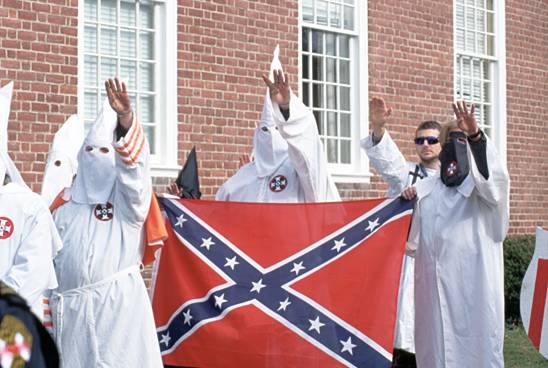
REBEL WITH A RACIST CAUSE

If you haven’t heard much about Rand Paul, get ready. You’re going to hear a LOT about him in the days to come. Paul, an ophthalmologist from Kentucky won the GOP primary Tuesday night and is now full throttle in the race to become Kentucky’s next Senator. He may have won under the guise of the Republican party, but Paul is the ultimate hero of the Tea Party.

Remember, the Tea Party would have us believe its tenets have only to do with fiscal reform. Uh-huh. Why then, is controversy swirling bigtime around Paul’s recent comments about the Civil Rights Act of 1964? It seems he supports “most” of the Act, but one-tenth of it bothers him. He says he believes private businesses should not be subject to controls by the Federal government. He also claims he fully disagrees with any measure that would support re-segregating our society. Really? That is interesting, largely because if he had his way, apparently restaurants could still display “whites only” signs, and apartment complexes could decide not to rent to gay people. Paul can frame his comments however he chooses, but the bottom line is that not one political candidate in modern history has even remotely bashed the Civil Rights Act until now. He is treading on dangerous territory, and despite his comments to the contrary, what he is suggesting is clearly racist.

Who’s next on Paul’s hit list? Poor people? Illiterate people? Disabled people? To say Rand Paul is conservative would understate his views. Even Dick Cheney seems to be put off by Paul’s views. He backed the opposing candidate. By the way, Paul is so intent on reducing government in our culture, that he has publicly come out for eliminating the departments of education, commerce and energy. Oh, and here’s the rub: Kentucky has evolved into one of the most conservative states, and Paul has a shot at actually winning this race. Still, the Tea Party heartily endorses Paul’s candidacy. So, the question remains: If the Tea Party was founded for fiscal reform, why would it support a guy who could conceivably usher in a new era of segregated lunch counters? Is there some connection between all things fiscal and civil rights reform? Just asking. Listen to his comments on the Rachel Maddow show, and you be the judge:A couple of quick notes to Rand Paul: If I were a disabled person who went to work in that three-story building you mentioned: If the department for which I was hired is on the third floor, and you position me on the first floor because of my disability, I have a clear cause of action for discrimination. Further, if we roll back the Civil Rights Act of 1964 to the point that business owners can choose their patrons, have you considered there may be a number of businesses that do not choose you as a patron? If those businesses are important to you as a consumer, and if the Civil Rights Act of 1964 is deconstructed, on what basis would you argue for your own rights? Further, your Senatorial inexperience is showing: There will seldom be a piece of legislation that you support completely. You will have to make concessions and compromises as a U.S. Senator. In 1964, had you believed in “nine-tenths” of the Civil Rights Act, most likely you would have been compelled to vote for it.

Does Kentucky (or any state, for that matter) truly want a U.S. Senator whose views are obviously not fully formed? Is it possible Rand Paul needs to study the legislative landscape a bit more before attempting to become a legislator? Let’s hope so.

Monday, May 3, 2010

New Orleans Welcomes MAYOR MITCH LANDRIEU

Mayor Mitch Landrieu was innaugurated today on the steps of historic Gallier Hall in downtown New Orleans. Listen to his inspiring acceptance speech:

Thursday, April 29, 2010

CITY WITHOUT FEAR: New Orleans After Ray Nagin

Finally, and mercifully, New Orleanians can take a full breath as Mayor Ray Nagin is out of office. Find me a New Orleanian who says otherwise and I will show you someone who simply hasn’t been paying attention to the neglectful, laissez-faire, disinterested, uninvolved, apathetic two-term mayor. We are almost five years on from the great wave Katrina and subsequent crumbling of aged, ill-conceived levees. Although our city is remarkably resilient, and its people doggedly determined, these past five years could have been the most progressive in our 300-plus year history, had there been fierce and skilled leadership. There was not.

A few years before Katrina, one night I was at a gathering at an uptown New Orleans home, at which the Mayor was the honored guest. When he rose to speak I noticed several impressive things: First, he was impeccably dressed and groomed. But more importantly, he was articulate, full of enthusiasm for our city and determined to rid City Hall of its heritage of corruption. He spoke convincingly, and he was clearly comfortable in front of the news camera in the room.

Therein lies the problem with Ray Nagin: he is a nattily turned out chameleon who can tailor his suits and his words for whatever crowd happens to be present. Five months after Katrina, it was a very different Ray Nagin who stood on the steps of Gallier Hall on the holiday honoring Martin Luther King, and said this:
"We ask black people: it's time. It's time for us to come together. It's time for us to rebuild a New Orleans, the one that should be a chocolate New Orleans. And I don't care what people are saying Uptown or wherever they are. This city will be chocolate at the end of the day.”
That day he spoke with a twinge of dialect, and his earlier all-inclusive civic spirit had clearly dissipated. That was the day Nagin unwittingly wrote his own mayoral legacy. And that was the day the Mayor of New Orleans became a national punchline.

Every New Orleans citizen suffered for that and still does. You will please pardon the analogy, but the citizenry of New Orleans is a rich gumbo pot. Everybody gets to jump in. Yes, we are racially divided in a big way, but we are not a black city or a white city or a Creole city. We are richly diverse. Nagin did not understand the importance of honoring our diversity.

Some would say that is the least of our complaints about Ray Nagin. More importantly, after our 2005 tragedy, the mayor needed to firmly and decisively step up. He did not. He whined, bitched and complained about what victims we were. In doing so, he weakened us and victimized us. Had he been a savvy negotiator with the Feds, a good collaborator with Senator Mary Landrieu and Senator David Vitter, and one whose ego was less important than his dedication to the citizenry, the last five years could have put us on the fast track toward rebuilding the city.

That very citizenry voted him back in office for a second term, largely because many New Orleanians felt it was not a good time to shift gears to a new administration. We were in the middle of FEMA battles, Senate hearings, Katrina-related lawsuits, insurance companies trying to lowball the worst hit areas and more. It seemed logical to many citizens to maintain continuity. A new mayor, many reasoned, would set us back to square one. Nagin won the race (against Mitch Landrieu, our new mayor), and then essentially retired. We saw very little of him, we heard even less about his questionable whereabouts and by a year or two after the storm, we knew we were on our own.

In his last year in office, Nagin took up such causes as attempting to buy a downtown office building (right) to which he wished to move City Hall. The multi-million dollar enterprise was nixed by a city council that knew Nagin was not a reliable arbiter of the city’s welfare or budget. While Ninth Ward citizens continued to live elsewhere as their section of the city rotted, Nagin concerned himself with unrelated issues. For one, when an ordinance came up that would make it impossible for vendors with a history of corrupt practices to do business with the city, Nagin tried to veto it, essentially condoning criminal behavior. Once again, the city council had to step in and exercise its common sense.

Nagin operates independently, rather than cooperatively with individuals and groups that could advance the city's needs. Chief among his adversarial relationships is that with the media. Here is a typical example of how the mayor conducts himself with the press:

So, let’s review: Here is what we New Orleanians are left with as Ray Nagin smugly talks of moving into “disaster consulting.” A drive through the lower Ninth Ward reveals blocks that look much like they did the day after Hurricane Katrina. The local school public system is so fractured and disabled that some former board members are in jail, and some schools were taken over the by State. A large percentage of downtown office space sits empty. We have a police department that is slowly revealing itself to be ill-trained, poorly managed and corrupt. Because of the Danziger Bridge debacle, the Department of Justice is insinuating itself into local law enforcement. This, just as the local murder rate is spiking again and other crimes are on the increase. As Nagin strolls out of office, the city is seven months behind and $8 million in debt to the major contractor handling big recovery projects.

And here comes Mitch Landrieu. As mayor, we wonder if Landrieu will be able to offer hope to those who were displaced by the storm and never got to come back. Will the city’s business climate become more welcoming to the rest of the world, and will we finally have more industry than tourism and shipping? We wonder if the combination of a new police chief and Federal intervention will result in less crime, and we sure hope the extreme racial divide will narrow. One thing we have learned is not to place all of our dreams in the hands of the city leader. We learned we have to jump in and participate in the decision making process and monitor the administration’s performance. Most of all, we learned how resilient we are in the face of massive tragedy and governmental incompetence. We’re still standing. We don’t identify our city any more as “post-Katrina New Orleans.” Nagin was the last symbolic element of that, and now we’re moving on. We now view ourselves as a top-tier destination city in the country. Pack your bags and say goodnight, Ray.

Sunday, April 25, 2010

One Nation Divided, Part II: Crisis of Color


It was one of those rare balmy days in New Orleans when the air was perfect enough to allow me to keep my windows open. I could hear one of my neighbors talking to someone, and soon realized he was on the phone speaking to his son. I couldn’t help eavesdropping because I’m just that nosey:
“I don’t hate white people, but listen, you can’t trust them," he said. "If you think those guys you work with are your friends, just wait until it comes down to you or them to take the rap for something on the job. They’ll turn on you so fast you won’t know what hit you. My grandma taught me that and I never forgot it. That’s just how they are.”
The racial divide in this country is worse now than it has ever been in my lifetime, including the Civil Rights era, when there was rioting in the streets, coast to coast. Anyone who thinks the black and white citizens of our country are harmoniously co-existing is delusional. Here’s some evidence:

• Headline: April 14, 2010, Reuters News: "Judge tells Mississippi schools to stop segregating." If you have never heard of the rural Mississippi borough of Walthall County, join the club. It seems tiny Walthall County has been systematically separating its white students and black students, despite the desegregation rulings handed down by the U.S. government more than 40 years ago. Not only have hundreds of white students been allowed to transfer outside of their residential district so as to not have to attend classes with black students; but even those schools who mix races in the buildings have classrooms for whites and classrooms for blacks. In 2010. Worth noting is that the revelation about Walthall County comes just days before the Student Nonviolent Coordinating Committee (“Snick”) holds its 50th reunion, 836 miles away in Raleigh, NC. Snick was a group of young people, including emerging luminaries like GA Congressman John Lewis and NAACP President Julian Bond, who staged lunch counter sit ins, orchestrated the legendary Freedom Rides and staged countless peaceful demonstrations in the name of civil rights. As they gather, there will no doubt be a societal cloud looming over their festivities, brought on by Tea Party demonstrators who called John Lewis a nigger during the recent health care debates. Walthall County’s decades-long defiance of desegregation laws will likely be a pervasive topic.

• Virginia Gov. Bob McDonnell declared April “Confederate History Month.” Not only were vast numbers of Virginians offended by McDonnell’s recognition of the Confederacy, but the fact that slavery was not even mentioned was a clear indication that the Governor did not see this historical abomination as significant at all. After much public protest, McDonnell revised his proclamation to include mention of slavery. The annual commemoration of the Confederacy bit the dust back in 2001, but McDonnell brought it back, saying, “"I felt just as I've issued dozens and dozens of other commemorations, that it was something that was worthy of doing so people can at least study and understand that period of Virginia history and how it impacts us today.” Is Bob just nostalgic for the good ole slavery days, or is this really a political move to strengthen his position with his base supporters? It is most likely the latter, but what does that say about the mindset of his supporters?

• Mississippi Governor Haley Barbour just could not see what all the fuss was about after all hell broke out in response to McDonnell’s proclamation. Said he: “To me, it’s a sort of feeling that it’s a nit, that it is not significant, that it’s not a — it’s trying to make a big deal out of something (that) doesn’t amount to diddly.” Interestingly enough, the Governor’s mansion is less than 100 miles from soon-to-be infamous Walthall County. Even more interesting is that Barbour also declared April in Mississippi to be “Confederate Heritage Month,” calling on his citizens to celebrate the “rich heritage” of the Confederacy. Like his GOP colleague in Virginia, Barbour made no mention of slavery in his proclamation, even in a state with the highest percentage of black citizens in the U.S. For a guy who is rumored to be considering a Presidential run in 2012, Barbour emerges as something of a figure with his head in the sand. Note to Haley: What plays in Mississippi does not stay in Mississippi.

• The Southern Poverty Law center released findings that from 2000 to 2008, the number of hate groups in the U.S. rose by 50%. According to the U.S. Department of Justice, in 2008, 72.9 percent of hate crime victims were targeted by attackers with an anti-black bias.

• The emerging Tea Party was ostensibly formed so that politically and fiscally conservative citizens could form a collective voice to protest the 2008 bailouts and the 2009 stimulus package. While the party members continue to claim that racism is not inherent in its followers, those who attend Tea Party events suggest otherwise. Anecdotal reports show that protestors routinely carry signs with racist connotations, often directed at President Obama. Typical of those signs: “Cap Congress and trade Obama back to Kenya.” Others carry signs with renderings of Obama as Hitler. Radio entertainer Rush Limbaugh and a number of his neocon cronies say it’s much ado about nothing, and that Tea Partiers are not racist. Right.

The American culture has a tendency to focus on very few issues at a time. (Best evidence? Financial reform didn’t go front burner until healthcare simmered down). So, in the 1960’s, we focused on Vietnam and civil rights, two seemingly disparate societal issues. When Vietnam was finally settled, did the civil rights movement lose momentum at the same time? Maybe. And that is unfortunate for all of us. As mentioned earlier, the racial divide in this country is more evident than ever, and with an economy that has tanked and stayed sluggish, frustration and anger are front and center. Is it just me or does it seem like racial tension is reaching a boiling part in many quarters around the U.S.? If you lived through the 1960s, you know exactly what I am talking about. If you were not around at that time, stay tuned, stay alert and watch your back.

Wednesday, March 24, 2010

One Nation, Under God...DIVISIBLE

Growing up in the 1960s, every morning in school we had to recite the Pledge of Allegiance, followed by the singing of “My Country ‘Tis of Thee.” We would stand by our desks with our right hand over our hearts – every single day. There are so many words in those two pieces that simply don’t work anymore. First, in the Pledge, we would say, in part, “…one nation, under God, indivisible, with liberty and justice for all.” By the late sixties we found out that our country was indeed divisible, and liberty and justice were relative terms. Today, there is controversy brewing even over the use of “God” in the Pledge. Citizens coast to coast are questioning the concept of liberty in America, throwing around words like socialism and dictatorship. And justice? Well, according to some Americans, justice has everything to do with your skin color, sexual orientation and/or socio-economic status. America is divided right now unlike any other time in history, except for the Civil War in the 19th century and the Civil Rights Movement in the 1960s. We are fractured. We all know it, even though we go on about our daily lives as though we were still that America that pledged and sang every morning.

After the divisive health care debate last week, the façade that we have counted on for so long began to crumble. Here are a few recent examples of how divisible our country has become:
• Item: John Lewis, U.S. Representative from Georgia’s 5th District, who once marched his heart out with Dr. Martin Luther King from Selma to Montgomery, and who was viciously beaten by police (left) for doing so, was once again victimized last week. On his way into the Capitol, Tea Party members demonstrating against the soon-to-be-voted on health care bill yelled, “Kill the bill, nigger.”
• Item: Barney Frank, U.S. Representative from Massachusetts’s 4th District, distinguished as one of the first openly gay members of the House, was called “homo” and “faggot” as he approached the Capitol.
• Item: An Alabama man, Mike Vanderboegh, who refers to himself as a “militia leader” is openly leading an effort to break windows in Democratic party headquarters coast to coast. The movement has succeeded so far in doing so in Arizona, Kansas, Rochester, NY and Niagara Falls. On his blog, he writes, “Break them and run to break again. Break them under cover of night. Break them in broad daylight. Break them and await arrest in willful, principled civil disobedience. Break them with rocks. Break them with slingshots. Break them with baseball bats.”
• Item: Reportedly, as many as 10 members of Congress have requested added security for their homes and offices. Some have received death threats. Watch:


• Item: Rep. Louise Slaughter, of Niagara Falls, one of those whose office windows were broken, reports that a voice mail was left on her office phone threatening to “assassinate” the children of lawmakers who vote in favor of the health care bill.

The anger many Americans feel right now is often exacerbated by talk radio hosts, such as Rush Limbaugh. Recently, Limbaugh said some surgeries cost about the same thing as buying a new car, so if one can buy a car he should be able to pay for his own operation, without health insurance. He also told a caller who said he broke his wrist and had to pay $6,000 out of pocket for treatment, “Then you shouldn’t have broken your wrist.” Entertainer Glenn Beck called last weekend’s vote on health care reform an “affront to God,” because it was being conducted on a Sunday. Beck, of course, is the one who recently told his listeners to leave their churches if they were being encouraged to support social or economic justice. He invoked communism and Nazism in his rhetoric.

Sean Hannity has been getting himself so worked up over healthcare reform lately that he appears ready for his first stroke. Of course, this comes just as it was revealed that his and Oliver North’s charity, Freedom Alliance, is spending inordinate amounts of its donations on travel, perks and accommodations, and donating only 12% of its revenues to the children of wounded soldiers education funds.

What we are witnessing now is much like what we saw during the Civil Rights Movement in the 1960s, except with a high tech element. Talking heads are rallying their troops to fight the government in the name of freedom. Those among them without health insurance have yet to tell us how their medical expenses will be paid if they get sick. They will expect to be promptly and well-treated in emergency rooms coast to coast, without insurance. Further, even if their objection to national health insurance were valid, we have yet to hear from them any viable alternatives. All we have heard so far is that Americans should have a choice whether to be insured or not. If a grass roots movement is to gather true steam, it needs substance. It cannot go the distance on hate alone.

When supporters of health care reform point out that auto insurance is required of every driver, opponents say we are comparing apples and oranges. Are we? I think not. When supporters of health care reform point out that Medicare and Social Security could be considered just as socialist as the new reform, the opponents do not seem to respond. But they do expect their Medicare reimbursement and social security checks to arrive on time.

We are indeed a nation divided by ideology, temperament and intolerance. Racism is boiling, anti-government rhetoric has turned threatening and vile, and grass roots organizers are protesting the very initiatives that were designed to allow them to enjoy their freedom, not rob them of it. Violence, death threats and uncivil disobedience notwithstanding, however, this too shall pass. Just as the violence that rocked urban streets in the late 1960s in opposition to racial equality passed, this will pass. Still, how many broken bodies and spirits will lie in its wake is yet to be seen.

Saturday, March 20, 2010

IS POPE BENEDICT XVI THE NEW RICHARD NIXON?

For the past decade, the Catholic priesthood has become synonymous with pedophilia. That is unfortunate, because the odds are that the majority of priests do not sexually abuse children. However, enough of them have done so that now, we laypeople out here are highly suspicious of Catholic priests. Reportedly, the U.S. dioceses have paid up to $2 billion in victim settlements in the past eight years. Who can forget former Archbishop Bernard Francis Law of Boston, whose complicity in covering up sexual abuse of children by priests resulted in his resignation? For those who haven’t thought much of Law since his resignation, you should know he is currently serving in Rome as an “archpriest,” which means he is the authority over several parishes. He is also a member of the Pontifical Council for the Family, which the Catholic Church defines as the body that "promotes the pastoral care of families, protects their rights and dignity in the Church and in civil society.” Law is typical in the church, in that even priests who have personally fondled children or raped them are currently still the in the papal fold. They are often just moved to different geographic locations and placed in lower profile positions.

Just to put the issue of sexual abuse by priests in perspective, watch and listen to the courtroom testimony of Father Patrick Gerald O’Donnell of Spokane, who admitted sexually molesting more than 30 teenage boys, many of them inside the church rectory.

Is it just me, or does there seem to be some dangerous disconnect between the Vatican and societal morality? Lately, the church’s morality has been called into question throughout Europe. Among the most high profile issues that Pope Benedict XVI has to deal with right now is alleged misconduct on the part of his own brother, George Ratzinger. Ratzinger has publicly admitted that sexual abuse of members of a boys’ choir occurred in Regensburg, Germany. Ratzinger directed the school where the abuse happened for three decades. For his part, the Pope says he knew nothing about it. Oh, apparently the Pope also knew nothing of Ratzinger’s common practice of slapping children in the face to discipline them. Are you buying any of this? No, I didn’t think you were. The Pope thinks we’re buying it. That has to do with powerful, egotistical leaders in religion, industry and government worldwide who believe their own b.s. and somehow convince themselves that you will believe it, too.

Does it sound a little Richard Nixonish to you? It does to me. When illegal behavior was taking place in all of the ranks that reported to then-President Nixon back in the early 1970s, Nixon’s initial position was one of complete ignorance. Of course,later we found out that he knew everything and even helped to keep it quiet. Does the Pope know everything, and how much has he done and is he currently doing to keep it quiet? Nixon resigned. Should Pope Benedict resign? Some say absolutely he should. It’s not the first time a Pope has had to step down. Okay, it last happened 600 years ago, but who’s counting years when supposed holy men across the globe are raping children?

Not the 53-year-old Austrian man who recently went on the radio to detail his own sexual abuse at the hands of Austrian priests decades ago. His story is quite telling, because the alleged abuser, Bruno Becker, offered the victim 5,000 Euros ($6,790) to keep quiet about it, calling the payment compensation, rather than hush money. That, of course begs the question: How does the church decide how much cash to ante up for prolonged and repeated incidents of molestation? Did Becker just pull that figure of 5,000 Euros out of thin air? And if so, is there truly anything arbitrary about child rape? Is oral sex worth more Euros than say, genital fondling? Who gets the highest payment? Those who experienced penetration? Is there a sliding scale? I think not, and clearly the church thinks not, because the church is currently shaking in its holy boots as one report after another surfaces about priests using boys for sexual gratification. And so far, the church has been quite mixed in its reaction to European reports.

For example, the spokesperson (read: PR flack) for the Vatican, Federico Lombardi, was arrogant enough to make the following comment in the midst of the mounting reports of abuse: "All objective and informed people know that the issue [of child sexual abuse] is much wider, and to focus accusations only on the Church leads to a skewed perspective." So, if I’m hearing this correctly, Lombardi is saying, ‘everybody’s doing it, so don’t pick on us.’ Again, is it just me, or is there an incomprehensible disconnect between the Vatican and the world at large? Let’s pull numbers out of the air like the church does: If say, oh, I don’t know…10% of child sexual abuse happens through the church and 90% happens everywhere else, should that 10% get a free pass? Lombardi is desperate, and therefore, we know the Pope is desperate. Kind of like Richard Nixon was desperate when he knew he could no longer hide the illegal activity of his administration.

By some estimates, there are more than 14,000 known victims of sexual abuse by U.S. priests since the 1960’s by up to 5,000 priests. And that’s just one country. How many children have had to live with their own dirty little secrets worldwide, many who will never feel able to come forward with their stories? Right now, for example, the Dutch Catholic church is relying on an independent commission to investigate more than 200 claims of reported sexual abuse by priests. In addition to Ratzinger’s school, priests in two other Catholic schools in Germany stand accused of beating and sexually molesting students. In Ireland the issue has become so pervasive that the Irish government issued a report that clearly details widespread sexual abuse of children by priests over the past three decades. Pope Benedict recently called Irish bishops to Rome to reprimand them. A nice high-profile p.r. move, but who is being held accountable and will anybody go to jail?

That’s the billion-dollar question. Why aren’t the rapists being put away for life like other rapists? If U.S. Congressmen raped children, would they be simply reprimanded? If executives with Microsoft, AIG or Bank of America raped children, would they just be reassigned to another city in a different position? If Harvard University teachers raped children, would they merely be called into the Chancellor’s office and slapped on the wrist? What is going on here with the Catholic Church and why are not hundreds or perhaps thousands of priests worldwide being tried in courtrooms and sent to prison with all of the other pedophiles and rapists?

And, finally: What is it that attracts pedophiles to the priesthood, and is this really the bigger issue at hand? If there is a silent, clandestine understanding somewhere that the priesthood has an immoral sexual component that has been covertly perpetuating child rape for decades and decades, perhaps the gig is finally up. The buck stops with Benedict. For my part, I am just egalitarian enough to be fully ready for this criminal sin to be stopped now. If the Pope is complicit in this dangerous sham, he needs to resign now. His successor needs to take on the international crimes of sexual abuse by priests as job one. And governments, worldwide, need to prosecute priests in the exact same judicial manner they treat all other pedophiles and rapists.

Thursday, March 11, 2010

NATIONAL ENQUIRER & PULITZER PRIZE: MUTUALLY EXCLUSIVE?

Here are nine worlds I never thought I would write:
The National Enquirer is up for a Pulitzer Prize.
Before I ask you to wrap your mind around those nine words, let’s review a little history about the Enquirer. First, it is interesting to note that the paper has been publishing continuously since 1926. I won’t bore you with the long history of the paper, but if you’re so inclined you can read about it here.

The Enquirer claims it has a circulation of over a million, and that more than nine million people actually read it each week. Those figures are probably high, especially in light of the fact that in the last couple of years the paper has imposed five-day unpaid furloughs on its employees. Papers do not do that unless finances are tight, and finances are not tight unless advertising is down. So, like other newspapers in the country, it is clear that the Enquirer is not cash-rich right now. However, as it turns out, there would be other kinds of riches awaiting the much-maligned Enquirer.

Who could have predicted it would take the sexual dalliances of a Democratic presidential candidate in 2008 to elevate the gravitas of what most Americans considered a rag? Up until candidate John Edwards gave in to his carnal desires with a campaign worker, the Enquirer had a loyal audience who couldn’t resist its salacious editorial offerings, but who rarely really believed much of it. When it was revealed that the Enquirer was right about Edwards, suddenly a lot of us started scratching our heads in disbelief. Then the mainstream media slowly started reporting the story, as if they had initiated it. But the Enquirer was relentless in its coverage, which its owners today say they never paid for. Checkbook journalism had become synonymous with the National Enquirer, but not this time. It was not until the second week in August, 2008, when Edwards fessed about the affair on ABC News that any mainstream publication dared print the story.

All of this brings us back to the nine words: The National Enquirer is up for a Pulitzer Prize – the highest and most prestigious award in journalism. As one who still recalls the days when the Enquirer was running stories about psychic nuns giving birth to aliens, this news is surreal. But it brings forth a number of provocative questions: Why did mainstream media resist their journalistic obligation to pursue the story when the evidence presented itself? If we accept the Enquirer’s contention that no money was paid for information, how did they break the story? And why will they not reveal how they initially got turned on to the story? Should they? They are not legally bound to do so, but from an ethical standpoint, before the Pulitzer board makes a decision, perhaps the Enquirer should come clean about how and from where this information was obtained.

Specifically, the Enquirer is up for investigative reporting and national news reporting awards. As a guy who was trained in traditional journalism, and one who today teaches journalism in a new media world, here is what I think: The Enquirer, despite its tactics, reputation and blatant resistance to conventional journalistic techniques, apparently 'gets' the new world of media, more than say, The Washington Post or The L.A. Times. The new world demands immediacy and stretching the limits of privacy. Why wouldn’t the mainstream media pursue this story? Simple. They didn’t go after the Edwards story because they underestimated the public’s hunger and demand for insider information about high profile people. Some of them probably considered it, but not one of them had the cojones to publish anything about it, simply because the only source of information at the time was the National Enquirer.

Like it or not, we are now in the high tech universe of TMZ.com and Perez Hilton. The more advanced the technology becomes, the more the public expects to know. As far back as 1920, when Photoplay Magazine became the first real movie fan magazine, the public slowly developed its desire to know the inside story of its cultural icons. By the 1970s when People Magazine debuted with Mia Farrow on the cover, that hunger for juicy details seemed to peak. But the real peak had to wait another 25 years or so for the Internet to evolve. Today, celebrities, politicians and other high profile types can essentially kiss their privacy goodbye. Even when they sue for intrusion of privacy, they generally lose, unless they can prove a case of appropriation of their name or likeness. Unfortunately for the John Edwards of the world, appropriation does not extend to news coverage.

So, will the Enquirer win a Pulitzer for its coverage of the John Edwards baby daddy scandal? In every category that is awarded, the prize description includes the words “distinguished example.” Was the Enquirer’s reporting a distinguished example of investigation or national news? I have a feeling the Pulitzer board will not see it that way. After all, we do know some details of the Enquirer’s methods here. Reporters apparently followed Rielle Hunter, Edwards’ lover, to her obstetrician’s office in order to secure photos of the pregnant woman. Reporters cornered John Edwards in a men’s room at the Beverly Hilton Hotel to confront him about the allegations of the affair and paternity. The paper did indeed pay for information about the John Edwards affair – even if they claim they did not pay for information that led to the exact stories that are up for a Pulitzer Prize. So, if we hold that the word “distinguished” refers to excellence, eminence or quality standards, it would seem the National Enquirer doesn’t really cut it.

Still, don’t forget this is not your father’s media world. Remember, the anti-journalist, Matt Drudge was the first reporter to publish the name Monica Lewinsky with initial details of Bill Clinton’s transgression. He was right and mainstream media followed his lead. Further, TMZ.com was the first media outlet to report that Michael Jackson was dead. The news was accurate and then CNN jumped on the bandwagon. The National Enquirer correctly reported in 2003 that Rush Limbaugh was addicted to painkillers, and this followed the paper’s 2001 breaking news that Jesse Jackson had fathered a love child. Do not underestimate alternative, non-mainstream or new media. The truth comes at you from odd places these days, and whether those places are worthy of traditional industry awards remains to be seen. I, for one, am on the edge of my seat.

Saturday, March 6, 2010

WHAT'S WRONG WITH THIS PICTURE?


If you want to see the true visual representation of print journalism’s desperation, stare at this picture for a moment. This is the actual front page of the Los Angeles Times, Friday, March 5, 2010. The newspaper that has published since 1881 and won 39 Pulitzer Prizes, has fallen victim to the international decline of the newspaper industry. Now that digital media has taken the fast track to gain the hearts and eyes of consumers, newspapers are doing what they can simply to survive. You are looking at the L.A. Times struggling to survive. The newspaper devoted its entire front page to a paid advertisement for the new Johnny Depp film, “Alice in Wonderland.” The news coverage that you see surrounding the picture is fake. The real page one of Friday’s Times is on the inside. The Times reportedly sold the space to Disney for a whopping $700,000 in badly needed revenue for the paper. The Times has radically reduced its staff in recent years, offered buyouts to many employees, and seen The Tribune Company, its corporate owner, file for bankruptcy. You are looking at the unfortunate result of a major cultural shift in the world of journalism. So, what is to become of the Times? Conventional wisdom says it will probably keep experimenting until it settles into its new identity. As Alice says in “Alice in Wonderland,” “…at least I know who I was when I got up this morning, but I think I must have been changed several times since then.”

Saturday, February 20, 2010

AMERICAN BODY COUNT

How desperate must an American man be to fly a small airplane into an IRS building? What drove Joe Stack to make such a deadly statement to his fellow citizens last week? At the risk of being disrespectful to the deceased, I would posit that Stack’s desperate last move can be seen as merely a symptom of a much more pervasive crisis. Many American seem now consumed with a frantic powerlessness that increasingly shows itself in anti-government rage. How many Joe Stacks might there be out there? How many Americans are one more missed mortgage payment away from becoming a Joe Stack?

Stack, we learned after his fiery suicide, left a lengthy written explanation of his act. It revealed that his struggles with the IRS dated way back to the early 1980s, and that in the end, score one more for Big Brother:
ABC News summarized Stack’s frustration:

Stack’s story will resonate with many of his fellow citizens. Whether it is a battle with the bank to hold on to a home, or a plea to the State to extend unemployment payments, or a fight with an insurance company to cover a needed surgical procedure, many Americans are not concerned with their personal dignity as much as they are with simple survival. Some, like Stack simply run out of steam. The same day he flew into the IRS building, Stack had already burned his modest suburban house to the ground.

Because Stack’s violent move was so extreme, media was (and is) all over it. But what about Terry Hoskins of tiny Moscow, Ohio? The same week that Stack did himself in, Hoskins drove a bulldozer into his $350,000 home and leveled it. Nothing left. Just boards and roof tiles. Hoskins, who had never once missed a payment on his home, was another IRS target. The home was cross collateral for his business, which was in deep debt to the government. Instead of allowing the bank to foreclose, he destroyed it. Watch:

A little over a year ago, Ervin Lupoe went much further than Hoskins. Lupoe, in deep financial distress with the IRS and his mortgage holder, shot and killed his wife and five children,(below, right) and then himself. It is the brand of murder-suicide that makes no distinction among race, geographic location or prior socio-economic status. Desperation is desperation.

So, what is really going on here? In his suicide note, Stack mentions the need for a body count to affect change in America. As usual, the numbers tell the unbiased truth. Consider: More Americans have been unemployed for six months or more than at any time since 1948. One of the fastest growing population segments of unemployed are women between the ages of 45 and 64. More than 15 million Americans are officially unemployed, but that figure does not reflect thousands who are no longer looking for work because they gave up. And then there are the Catch-22 victims: There are Americans who are denied food stamps because they are deemed to be bringing in too much money on unemployment. There are others who would like to go to work even for minimum wage, but actually bring in more on unemployment than they would after their paycheck is taxed.

Was Joe Stack a domestic terrorist or spokesman for desperate Americans? Was he truly experiencing insanity, as many quickly claimed, or was he simply expressing his resignation after decades of trying to live? You be the judge. It is telling that a number of online groups have surfaced in support of Stack, who wrote this in his suicide message:
“I know I’m hardly the first one to decide I have had all I can stand.
It has always been a myth that people have stopped dying for their
freedom in this country, and it isn’t limited to the blacks, and poor
immigrants. I know there have been countless before me and there are
sure to be as many after. But I also know that by not adding my body to
the count, I insure nothing will change. I choose to not keep looking
over my shoulder at “big brother” while he strips my carcass, I choose
not to ignore what is going on all around me, I choose not to pretend
that business as usual won’t continue; I have just had enough.”

Wednesday, February 17, 2010

PLAGIARISM: WRITERS ROBBING WRITERS

Is it just me or does it not seem there has been a whole lotta mixing going on lately? What’s that you say? What’s mixing? Oh, sorry…that’s where you take someone else’s words and use them as your own in something you are writing. We writers call that plagiarism. Oh no it’s not, says 17-year-old German novelist Helene Hegemann. It’s mixing. From the mouths of babes, huh?

Hegemann wrote a novel called “Axolotl Roadkill” that ascended the best seller list in Germany until it reached lofty number five. Pretty heady stuff, but wait, there’s more. Then she was nominated for a prestigious writing award in Germany that came with $20,000. Later, it seemed to outsiders like her fairy tale overnight success would all come crumbling down. It was revealed that some of the passages in her book were word-for-word the same as in another book, “Strobo,” by Airen. After that, more passages were found to have been lifted from other sources.

According to the New York Times young Ms. Hegemann (below, right) was unfazed. She nonchalantly offered, “There’s no such thing as originality anyway, just authenticity.” She went on to explain that she’s part of a new generation that freely “samples” material from one place to another.

Hegemann is 17 years old in a literary world that made the rules long, long before her parents made her. Not so long ago, Germany formally subscribed to the European Copyright Law. Without boring you with the details, here’s the juicy part: Authors own their material for their entire lives plus 70 years after their deaths. So, since Airen is alive and well, it would seem that Ms. Hegemann has blatantly broken the copyright law. No sweat, says Hegemann: "I myself don't feel it is stealing,” she told a German newspaper, “because I put all the material into a completely different and unique context and from the outset consistently promoted the fact that none of that is actually by me." Spoken like a true 17 year old.

Too little, too late, say the critics worldwide. Ms. Hegemann, in the real world, we do call it stealing and we have a very special vocabulary word just for this… “plagiarism.”

Who would know better than one Gerald Posner, (left) who until last week was chief investigative reporter for The Daily Beast. That was until he resigned amid plagiarism allegations. It seems the Miami-based author was lifting entire passages directly from The Miami Herald newspaper and virtually cutting and pasting them into his online reports. Here is an example of Posner’s “mixing.”
Posner’s July 29 piece in the Daily Beast:
The new law, passed nearly unanimously in the legislature, requires doctors and pharmacists to record patient prescriptions for most drugs in a state-controlled database.
The Miami Herald, June 19:
The new law, passed nearly unanimously in the Legislature, will require doctors and pharmacists to record patient prescriptions for most drugs in a state-controlled database.
If you want to see more examples, check out Jack Shaffer’s Feb 8 piece on Slate.com.

Just as the media world was reeling from Posner’s stupidity came word that New York Times business reporter Zachery Kouwe is being cut from the paper because of his own plagiaristic transgressions. Kouwe apparently lifted exact passages from the Wall Street Journal and Reuters and published them in his Times reports. And who wouldn’t love this response from the young reporter? “As soon as I saw, I guess, like six examples, I said to myself, 'Man what an idiot. What I was thinking?'" Kouwe told the New York Observer. "I was stupid and careless and fucked up and thought it was my own stuff, or it somehow slipped in there. I think that's what probably happened."

While Helene Hegemann would dismiss Kouwe’s “fuckups” simply as a new generation writing its own rules on ownership and use of intellectual property, the powers that be at the Times think otherwise. Here is what they had to say on their corrections page after Kouwe’s “mixing” came to light:
“Copying language directly from other news organizations without providing attribution — even if the facts are independently verified — is a serious violation of Times policy and basic journalistic standards. It should not have occurred. The matter remains under investigation by The Times, which will take appropriate action consistent with our standards to protect the integrity of our journalism.”
So, what is really going on here? Is it simply that there is such a massive amount of information out there in the blogosphere and elsewhere on the Web that writers convince themselves that no one will notice if they lift a few passages here and there from previously published material? Is it that Hegemann is actually stating the prevailing (albeit twisted) mindset of her generation? Or is it simply true that each of the three writers in this piece are guilty of plain old school plagiarism? And if so, have the copyright laws in the U.S. and the European Union simply not caught up with the technology that enables writers to cut and paste other writers' stuff into their own work?

I am discouraged that people like Hegemann say things such as, “There’s no such thing as originality anyway…” I find it disheartening that that Kouwe, a guy with a master’s degree in journalism who got a job at arguably the most important newspaper in the world, would cavalierly write off his violation of the paper’s honor code as a “fuck up.” And for his part, Gerald Posner said, “The core of my problem was in shifting from that of a book writer – with two years or more on a project – to what I describe as the “warp speed of the net.”

I would like to respond to each. To Hegemann: If you believe there is no such thing as originality, then you have chosen the wrong path. Art might sometimes be derivative, but it is not to be duplicated. To Kouwe: Everything is not disposable, including a golden opportunity to write for the New York Times. As a guy in your early 30s, you come from a generation that somehow sees such an opportunity as “just a job,” where you simply “fucked up.” Someday, I predict, you will look back on this event in your life as pivotal, and be amazed at what an avoidable loss this was. And to Posner: We writers all had to adapt to a faster information pace when we decided to shift our efforts to online journalism. When you agreed with Tina Brown’s decision to hire you, you made a choice to keep up with that new pace. When you found you could not do so, your real responsibility (moral and industrial) was to resign. Lifting material from a daily newspaper was not an option. And you knew that all along, each time you consciously decided to do it.

Hey, if it sounds judgmental, so be it.

I still like the old rules. They have kept most of us on the straight and narrow for a long time. Let’s not fix what ain’t broke.