Showing posts with label police brutality. Show all posts

Monday, December 8, 2014

WE ARE ERIC GARNER

 Eric Garner was a 44-year old black American, married with six children, living in New York, about 350 pounds and 6’4” tall. I am a 61-year-old white American, unmarried, no children, living in New Orleans, 200 lbs, 6’1” tall. Garner reportedly had a string of about 30 arrests for petty crimes, and I have no arrest record. Eric Garner is dead and I am alive; yet I am Eric Garner. And guess what: You are Eric Garner.

If that sounds confusing, just know that you and I are but one unlawful misstep away from an overzealous, ego-inflated law enforcement officer placing us in a chokehold and cutting off our air supply. Maybe our chokehold may come from smoking an illegal joint, or jaywalking on a busy city street, or carrying the wrong item in our luggage through airport security, or cutting in line outside of busy nightclub, or….you fill in the blank. After all, would our getting high, walking in the wrong place, packing a pocket knife in a suitcase or being over-anxious to get into a club be any worse than Garner selling untaxed loosies? If Officer Daniel Pantaleo, 29, could murder Eric Garner in broad daylight on a busy Staten Island street, couldn’t any unnamed, over-testosteroned 20-something who spent a few months in the police academy take me out just as easily? So, you see, I am Eric Garner and you…yes you are Eric Garner.

And yes, indeed I did just use the world murder. I have watched the tape of Eric Garner’s takedown over and over again, and what I witnessed was clearly Daniel Pantaleo murdering Eric Garner.
Eric Garner in a chokehold (Inset: Daniel Pantaleo)
About Dan Pantaleo: Here are a few juicy items we have come to find out about the young cop who clearly saw no value in the life of Eric Garner: At the beginning of this year the NYPD settled a civil rights suit against him, after he and another cop stopped a convicted drug felon and made him and his friend drop their pants on the street and be searched. The officers then took the two to the station and strip searched them again. Since they were apparently unlawfully stopped, the two sued and each was awarded $15,000. Charges were dismissed. Charges were also dismissed in a separate case against a Pantaleo arrestee where the citizen alleges Pantaleo stopped him for no reason and filed a police report that accused him of crimes that were never committed. That person’s suit is still pending.

All of these suits hover around thousands of dollars charged to the NYPD. But that’s chump change compared to the $75 million Garner’s family will reportedly ask for in their suit against New York City. If you ask me, Pantaleo is a rather pricey employee for the city to keep, but so far he is still employed. Two days after Garner’s murder, Pantaleo had to surrender his gun and his badge, but he’s still on desk duty. One wonders how his hair trigger impulses will play out in the office setting, rather than on the street.

More about Pantaleo: After he cut off air supply to Eric Garner, while Garner lay on the street, barely
EMS worker checks for Eric Garner's pulse. No resuscitation efforts were made.
alive, Pantaleo and his four fellow officers on the scene did nothing to try to offer medical assistance. For five full minutes. Long enough to die. During the fourth minute, EMS workers on the scene took Garner’s pulse, but did nothing to try to resuscitate him.

Reaction to Pantaleo’s power trip and ultimate murder of Eric Garner has been swift and widespread, including Mayor DiBlasio of New York, who says he now fears for the life of his bi-racial son. None other than Judge Andrew Napolitano, the senior judicial analyst for Fox News said there should have been an indictment for criminally negligent homicide.

When Pantaleo issued a statement apologizing for Garner’s murder, Garner’s widow had this to say: "Hell no! The time for remorse would have been when my husband was yelling to breathe. No, I don't accept his apology. No, I could care less about his condolences. He's still working. He's still getting a paycheck. He's still feeding his kids, when my husband is six feet under and I'm looking for a way to feed my kids now. No, I could care less about his condolences," she continued. "Who's going to play Santa Claus for my grandkids this year?”
Esaw Garner

I’m with Mrs. Garner. How could you not be? My greatest concern is the selection process for these young cops. First, every local and state police organization requires officer applicants to go through a psychological evaluation, but none of them make the details of the evaluations or the individual results available to the public. Just how deeply are we delving in to the psyches of these 20-something, over-aggressive males who are patrolling our cities? Are they being adequately tested for behavior traits such as impulse control? Are they being deeply questioned and investigated as to their beliefs about racial issues? What do the hiring agents at these agencies know about the applicants’ family and peer influences as it regards race? Why are there so many instances of police brutality and over-use of excessive force that go unpunished? Could there really be a citizen in NYC who believes Dan Pantaleo should be put back out on the streets of their city?

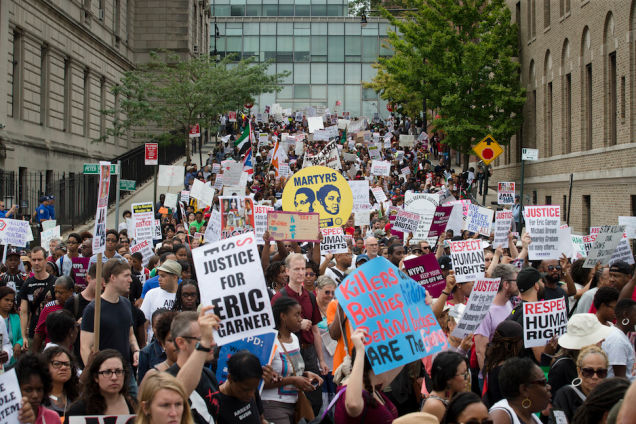
Think about that tonight and for many nights to come while you watch protests, demonstrations and even rioting in major cities coast to coast. The American public is speaking its collective mind about Eric Garner’s murder. That is because each of those individuals who braves the elements and spends his or her nights on the streets knows that they are all Eric Garner. We are all Eric Garner. Here is a clip of Mrs. Garner’s interview last Sunday on NBC’s “Meet the Press.” Listen to her describe the disrespect with which the police treated her husband and her on a daily basis. Listen to the fear she lives with for her two young sons.

Esaw Garner goes through her days in America in 2014 in fear. That is not what this country is supposed to be about. All Dan Pantaleo accomplished when he brutally murdered Eric Garner was to destroy an American family and bring to the surface the escalating problem of police brutality and the street war between police and the citizens they are charged to protect. When immature, 20-somethings are released on the street to “enforce” the law, having little life experience and almost no worldly wisdom from which to draw, we are all in danger. Put a gun in their hands and we are in mortal danger. If they have a history of falsely arresting people as Pantaleo has, the danger is even greater. America is fighting back now, as evidenced by the hundreds of thousands of citizens taking to the streets each night, from Ferguson to Staten Island, from Berkeley to D.C., from Detroit to Dallas. Speak up. Be heard. Don’t wait until nightfall, or until one of us Eric Garners is murdered again, or until someone else has to speak for you. 
Monday, September 29, 2014

THE NEW NORMAL: THE POLICE AS PUBLIC ENEMY


Levar Jones, 35, an assistant manager at a Subway store, was stopped in his hometown of Columbia, SC on September 4 for a seatbelt violation. After Officer Sean Groubert, 31, a State Trooper instructed Jones to produce his license, Jones, who was standing outside the vehicle, reached in the front seat to comply with the order. When he turned around, Groubert fired four shots in rapid succession, one hitting Jones in the hip. Nobody knows why Groubert fired, but other citizens will not have to worry about him, because once the powers that be saw the videotape from Groubert’s dashcam, Groubert was fired and charged with assault and battery of a high and aggravated nature for the shooting. He faces 20 years in prison if convicted. He will likely also face civil charges for assault or even federal civil rights charges over this incident. It bears mentioning that Groubert is white, and Jones is black. Here is the video from Groubert’s dashcam.


What you just witnessed could happen in your town or my town; in Peoria just as easily as in Poughkeepsie. Detroit, Provo, Anchorage, St. Louis, Galveston, Jersey City, you name it. Nationwide, urban, suburban and state police forces are hiring young people (mostly male), who complete what many might consider minimal training before being let loose on the streets, with firearms and a type of authority with which most people their age are unfamiliar.  State Trooper training in South Carolina lasts 17 weeks. That’s it. Poof.  Four months and you’re a cop. No college required, just a high school diploma or a GED. Oh, and you can do all of this at the tender age of just 21. Some of these rookie cops are so young they still live with mom and dad.

For the moment, let’s travel north to Brooklyn, NY, where that same 21-year-old can become an officer with the NYPD with six months of “intensive” training. Presumably, the unnamed Brooklyn officer who tackled a very pregnant Sandra Amezquita to the ground on a city street had undergone that training. Amezquita was trying to intervene as officers arrested her 17-year-old son. Before she was violently forced to the ground, she was struck in the abdominal area with a police baton. Another woman, who tried to help Amezquita was forcefully pushed to the street by another officer.  Again, there is a video. Watch:


Of course both of these incidents come just weeks after Officer Darren Wilson, 28, shot and killed Michael Brown, 18 in Ferguson, MO, after Wilson considered Brown a suspect in the theft of some cigars. Wilson is a four-year “veteran” of the Ferguson police department, having served two years before that on the Jennings, MO police force. Wilson started his career at 22 years old.

While I cannot authoritatively comment on the personal lives and backgrounds of Groubert, the unnamed Brooklyn cop or Wilson, let’s just say there is an obvious pattern of brutality and abuse in these cases, and they are not isolated incidents. Jones was complying with Groubert’s order; Amezquita was visibly pregnant, and Brown, unarmed, allegedly had his hands up in the air when he was shot. 

As usual, the numbers tell the story: 
  • The FBI reports that a white police officer shot a black citizen on an average of twice a week in the seven years from 2005 to 2012 in the U.S.
  • ·Between 2003 and 2009, the U.S. Department of Justice reported that 4,813 people died while in the process of arrest or in the custody of law enforcement.
  •  The FBI stats indicate about 400 U.S. citizens each year are killed by police officers in acts of “justifiable homicide.” Compare that statistic to six in Australia, six in Germany and two in Australia.
  • As opposed to those citizens killed each year, in 2012 (the most recent year stats are available), 48 law enforcement officers were killed in the line of duty.
  •  The Lavar Jones incident is the 32nd officer-involved shooting in South Carolina in 2014, according to the South Carolina State Law Enforcement Division.
  •  Black Americans are killed by law enforcement officers in an inordinately higher percentage than white Americans. Case in point: Chicago. In 2012, there were 57 police shootings in Chicago. Fifty of those shot were black, according to the city's own published statistics.
Former S.C. State Trooper Sean Groubert
Having chewed on these and many other statistics for the past several days, there are a number of elements of this street war culture that occur to me.  First, every local and state police organization requires officer applicants to go through a psychological evaluation, but none of them make the details of the evaluations or the individual results available to the public. Just how deeply are we delving in to the psyches of these 20-something, over-testosteroned males who are patrolling our cities? Are they being adequately tested for behavior traits such as impulse control? Are they being deeply questioned and investigated as to their beliefs about racial issues? What do the hiring agents at these agencies know about the applicants’ family and peer influences as it regards race? Why are there so many instances of police brutality and over-use of excessive force that go unpunished?

As mentioned earlier, Grouber has been heavily charged in the South Carolina case, and the buzz now is that his attorney will use Post Traumatic Stress Disorder (PTSD) as a defense. We have no way of knowing if he suffers from PTSD, but the big question will be whether the South Carolina State Police even monitor their officers for PTSD. Is it even a topic of consideration? And if there is a rash of PTSD permeating our local and state police forces, how many other disordered, heavily armed cops are freely roaming our streets in or out of uniform?

To add to all of this, there appears to be a type of arms race between citizens on the street and law enforcement officers. There is an increased availability of firearms to almost everyone in this country, at the same time there appears to be a diminished respect for human life on both sides. That disturbing trend certainly showed itself in Ferguson, MO, when law enforcement produced military style weaponry and defense vehicles in preparation for violent rioting which never came.

I see our current cultural shift this way: Once everyday Americans become fearful of the police, rather than trusting, fewer and fewer will depend on law enforcement when the need arises. Already   
Former NOPD Officer Joshua Colclough and Wendell Allen
some citizens in heavily populated urban areas express their fear of calling the police. At the same time, once police begin to view citizens as alternately enemy combatants and expendable, no one is safe even in their own homes. Best evidence? In 2012, in my town, New Orleans, police executed a drug raid on a local home. One of the officers, Joshua Colclough, was walking up the stairs in the house when resident Wendell Allen appeared at the top of the stairs. Allen was unarmed and shirtless, and his hands were visible. Officer Colclough instantly shot Allen dead. After two years of legal wranglings, Colclough backed out of a plea deal to plead guilty to negligent homicide and was ultimately found guilty of manslaughter. His sentence? Four years in prison. Said Allen’s mother of her dead son: “He was my everything. He was my superstar.”

For the record, the white Colclough was 27 at the time of the murder (my word), and the black Allen was 20 years old.

Colclough’s case is not unique to New Orleans. Until law enforcement agencies make applicant requirements more stringent, require more education for recruits and take psychological testing and monitoring more seriously, how many more Wendell Allens and Michael Browns will there be? And why are people like Darren Wilson and Joshua Colclough immune from murder charges in cases like theirs? Sure looks like cold blooded murder to me.

Fortunately, the citizenry is beginning to demand to be heard. On Friday, September 27, a citizen rally was held in Brooklyn (right)  to protest police violence.
This came just after the pregnant Sandra Amezquita incident. In Ferguson, MO, marchers recently held rallies demanding the resignation of Police Chief Thomas Jackson. In New Orleans, still a hotbed or violent crime, Police Chief Ronald Serpas recently resigned his post. Earlier this year, San Diego Police Chief William Lansdowne resigned amid a number of controversies, some involving officers’ unwarranted use of excessive force. One notable case involved an officer who shot and killed a 25-year-old mother in her kitchen because he believed she was about to attack him with a meat cleaver that turned out to be a vegetable peeler with a six-inch blade. 

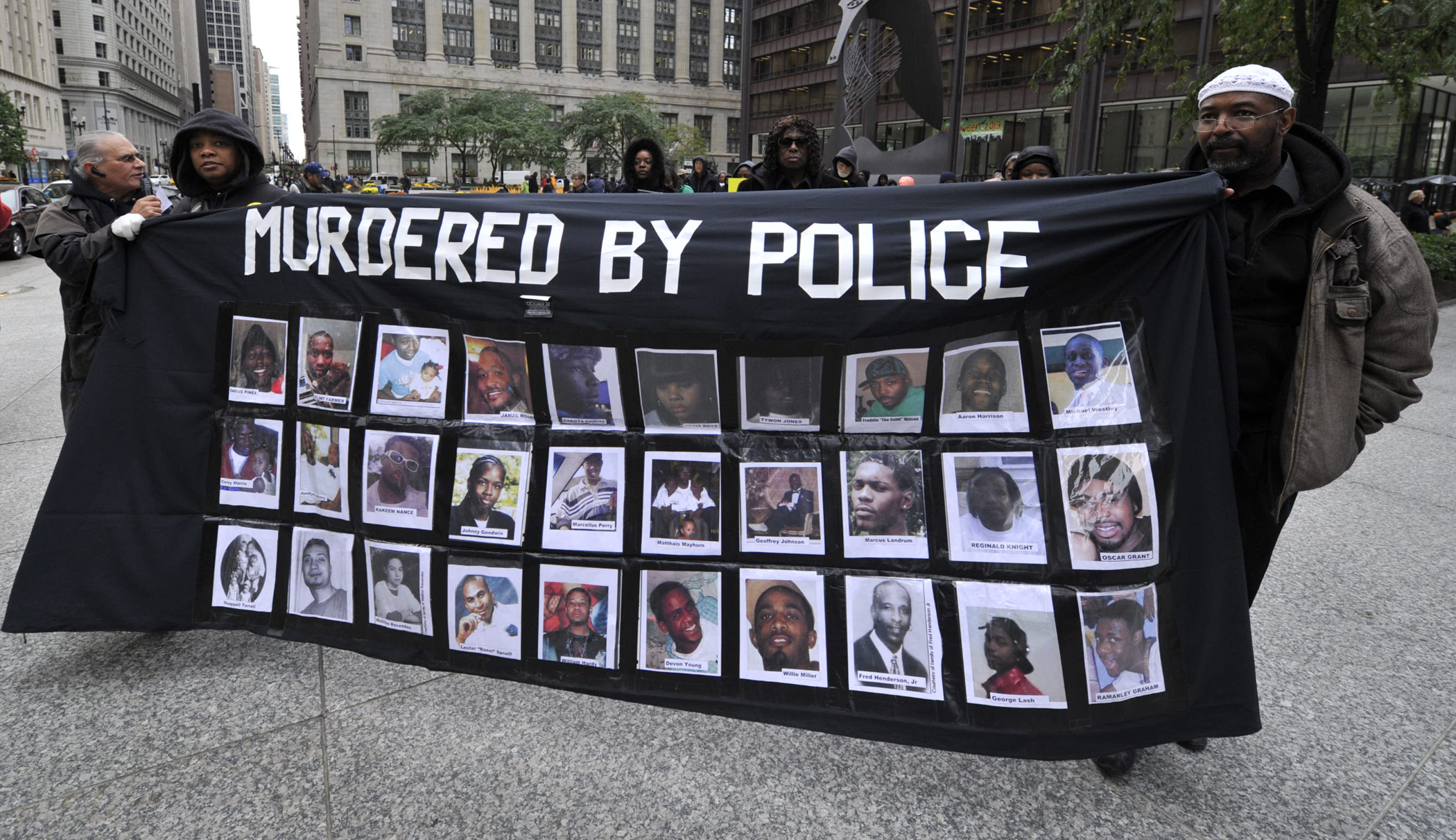
Marchers at the New York rally demanded the resignation of NYPD Chief Bill Bratton, carrying signs that said such things as “100 Chokeholds, 0 Cops fired; Who Runs this Town?”  Who, indeed.

Wednesday, November 23, 2011

UC DAVIS: A PORTRAIT IN OVER-REACTION

By now the photos of the campus cop at UC Davis pepper spraying passive, seated students has made its way around the world. Most people agree (with the exception of predictably obstinate cable talking head Bill O’Reilly) that the incident was uncalled for and unduly aggressive on the part of the campus police. Rational humans know not to spray chemicals in the faces of students seated in an outdoor area on their own campus. And those same rational people wonder now why the campus police showed up in full riot gear when there was clearly no indication of violence or anything but peaceful protest.

Close up photos of the still unidentified cop show an average looking guy, probably in his 40s. He’s not old enough to have the images burned into his memory of cops in the 1960s South spraying civil rights demonstrators with fire hoses.
He probably wasn’t around when students at Kent State were fired upon with live ammunition by the National Guard. It is likely he has no knowledge of dioxon-contaminated herbicide Agent Orange being routinely sprayed during the Vietnam War, reportedly resulting in hundreds of thousands of Vietnamese suffering health issues, not to mention American veterans who have suffered lifelong effects from the chemical. Would it have made any difference to the unidentified campus cop if he had these frames of reference? Hard to say. But did we as a society learn nothing from the above-mentioned incidents? It is inhumane for one human to spray another human with anything, when the intention is humiliation or bodily harm.

What is clear is the absolute violation of the students’ constitutional rights. As a gentle reminder, here is the first amendment to the U.S. Constitution:
“Congress shall make no law respecting an establishment of religion, or prohibiting the free exercise thereof; or abridging the freedom of speech, or of the press; or the right of the people peaceably to assemble, and to petition the Government for a redress of grievances.”

Were not free speech and free assembly rights abridged here? It’s tough to validate the campus police actions when you watch carefully what really happened here. Watch for yourself:

Notice the campus cop hold the canister up and present it to the crowd before he sprays the protestors. One might say he was showboating, exercising a level of power he does not really have. Now, after the fact, one wonders why it took the university administration fully three days to suspend him from his duties. And why is it that the Chancellor, who reportedly directed the campus police to disperse the protesting crowd, did not address the student body until Monday, when the spraying occurred on Friday. Further, since the students were not exercising aggression or violence, why are none of them or their parents speaking up about the violation of their civil rights?

Throughout the U.S. in recent weeks there have been reports of police brutality, unjustifiable arrests, unreasonable use of force on the part of law enforcement and poorly executed crowd control. The job of police in urban areas is not to function as physical or ideological adversaries to the citizenry. Yet that is what we are seeing coast to coast. On college campuses, for the first time in decades there are signs of true student activism. Where better to protest governmental missteps and ill-advised decisions than on campuses where ideas are the foundation of the institutions? Yet at UC Davis it appears ideas are being challenged, rather than welcomed, and administrators somehow feel threatened by a few kids seated on a sidewalk.

The still unidentified cop should be fired, and with him should go his superiors. If Chancellor Linda Katehi (below, left) ordered or approved of the use of force she overstepped her authority. The message all of them sent to their students is simply that in America one cannot peacefully protest that which he or she deems unacceptable.
Somebody forgot to tell Katehi and her police force that if there is one place in America where the free exchange and expression of ideas should be encouraged – popular or not – it should be our universities. Have UC’s administrators become so caught up in the business end of education that they have lost sight of the importance of student’s questioning the status quo?

It appears the pepper-spraying campus cop did not break any laws by using chemical dispersants. Still, how many unwritten moral laws were ignored in that one momentary act? Did the university administration not have an ethical obligation to allow or even encourage its student population to exercise their first amendment rights? Rights. Plural. Freedom of speech and freedom of assembly.

In fairness, and to her credit, Katehi addressed the students on Monday and apologized on behalf of the university. She spoke of not wanting to be a chancellor in a university that conducts itself as UC did on Friday. She said she wants to get to know the students. Her short address seemed heartfelt, but at this writing, the cops involved in this injustice are still on the payroll, although suspended. And why is it that it took this heinous act on the part of an over-zealous campus cop to cause the chancellor to finally want to get to know her students? Was there no reason to get to know them when all was calm and orderly?

The higher ups at UC Davis have a lot of explaining and apologizing to do. And the students who participated in the demonstration must learn to continually stand up – or sit down – for their beliefs. It is about passion, commitment and justice. One wonders how the adults at UC Davis forgot that last Friday afternoon.

Thursday, August 25, 2011

CAN YOU BE ARRESTED FOR VIDEOTAPING THIS?

Consider this scenario: You stumble upon a situation on the street in which you see what appears to be someone being harassed by the police. The subject of the harassment is in compliance with the police officers’ orders, but he or she is still being physically and/or verbally tormented. You know there is not much you can do to intervene, but it occurs to you that you can use your own smart phone to videotape the scene, so you do. Are you within your legal rights to do so? Is there any difference between videotaping police business in public, and videotaping anything else in public?

The answer to those questions appears fuzzy at this time. Just ask Emily good, a 28-year-old Rochester, NY woman who was arrested earlier this summer for videotaping police conducting a traffic stop in front of her house. She used her video camera while standing in her own front yard. She was charged with a misdemeanor for “obstructing governmental administration.” In truth, she was not obstructing anything. Obstruct means to prevent or hinder. She did neither. The charges were later dismissed. Watch what happened:


If Good’s experience were an isolated incident, perhaps we could chalk it up to just one cop exerting power over one citizen in an inappropriate fashion. But it is not isolated. It seems to be happening rather routinely coast to coast. Last year, Hartford County, MD resident Anthony Graber operated his motorcycle on the interstate highway at a high speed. He was pulled over for speeding by a man who identified himself as a state police officer. The officer was not in uniform and was driving an unmarked car. He approached Graber inexplicably holding a gun in his right hand. Graber was wearing a helmet with a camera in it and caught the incident on tape. When he posted the tape online a few days later, he was arrested for a felony charge of violating the state’s wiretapping law. Graber was jailed for 26 hours, not for speeding, but for videotaping the officer. The charges were later dismissed. Here is a report from CBS affiliate WJZ:

If you still question how common these types of arrests are, go to YouTube and put in the search term, “Arrested for videotaping police.” You may be surprised. These incidents beg the question: Does the Constitution protect your right to use cameras or video equipment as you see fit? Many argue the First Amendment protects us in that regard. Does the law vary from state to state or is there federal blanket protection of your rights? In the Maryland incident, Graber was arrested for wiretapping. Wiretapping is by its very nature a clandestine procedure. One does not allow the subject of a wiretap to know he or she is being listened to. Graber’s helmet camera was visible. Nothing was being hidden from the officer. That may have contributed to the charges being dropped.

And what about all the possible variables? What if you are filming your kids in the park, and in the background your camera picks up a cop physically assaulting someone? If your intention was to simply video your kids, but you later take the tape to law enforcement to report the cop’s illegal behavior, are you guilty of something? And what about a law enforcement officer’s illegal activity directed at you? If a cop asks or insists that you do something that is clearly illegal, strictly for his or her own gain or pleasure, and you tape it without the cop’s knowledge, have you somehow violated the law?

And it is not just law enforcement that is pushing the limits of your freedoms. Consider the town hall meeting that was held in Cincinnati this week. Congressman Steve Chabot (R-OH) issued a directive that attendees could not videotape any of the proceedings. Two television stations, however, were allowed to tape the whole meeting. When questioned by attendees who wanted to videotape the town hall, Chabot’s spokesperson said cameras were not allowed to “protect the privacy of constituents.” Watch what happened when two attendees (who were not together) each objected to having their cameras confiscated by a police officer charged with enforcing Chabot’s directive:

This makes one wonder what else the Congressman could insist upon in his town hall meeting. It should be noted that what appeared to be an open forum between him and his constituents actually was quite staged. Instead of allowing a free-flowing conversation, Chabot insisted that all questions had to be submitted to him and his staff before the town hall, and he chose to answer just those that suited him. If I were attending the meeting and my phone was confiscated, what if someone in my family had been trying to reach me to inform me of an emergency? I would not get the message until after the meeting. Chabot’s actions, which made national headlines the next day, appear to smack of First Amendment violations and censorship.

In short, here is what this is really about: Technology is advancing much faster than our ability to accommodate it legally and ethically. Suddenly we are all videographers, and we are relying on centuries-old laws and traditions to deal with our use of our modern equipment. Even if Chabot’s directive against video is somehow legal, is it ethical? Is there a difference between what I see through my own eyes and what I see through the lens of my video camera? Not really, but Chabot’s self-centered approach was to prevent widespread distribution of his comments via the Internet. He would deny it, but that was obviously his intention. By controlling his environment he restricts the flow of information. And again, doesn’t that imply his denial of the First Amendment?

Law enforcement employees (and they are indeed employees) and elected officials are clearly abusing their positions in the cases described herein and in many others. Until recently, the courts were not terribly sympathetic to citizen complaints regarding videotaping arrests. That seems to be slowly changing. The case some consider a watershed moment in this issue is that of Mitchell Crooks, a Las Vegas videographer who was beat up by Officer Derek Colling. Watch:

Colling, who has also been involved in the killings of two private citizens in the past five years, was put on paid suspension after this incident. That was in the first week of April. In July, a Vegas police internal investigation sustained Crooks’ complaint against Colling, which means Crooks’ case can go forward. That’s progress. Still, since Colling was found in violation of department policies, why is he still employed? It is clear from the video and from the department’s own findings that Colling physically assaulted Crooks, and that he purposely tried to destroy Crooks’ camera. If I did that, wouldn’t I be locked up? And how will the Vegas police make a case that their officer’s job performance was in any way obstructed by Crooks and his camera?

Here’s a thought: All that energy that cops and politicians are extending to cause videographers like you and me to stop using our equipment? Why not use that energy to combat another technological advancement that truly is a threat to all of us? Why not start arresting people for texting while driving? Texting behind the wheel is going to cause a lot more death and destruction than anybody’s video camera ever could. Just a thought. Are you listening officers? And how about you Congressmen and women…if you want to save your jobs and some lives all at the same time, consider it.