Showing posts with label First Amendment. Show all posts

Friday, September 26, 2014


You may not know it, but you could easily be on a government watch list for individuals who pose a terrorist threat.  I know; I know. It’s laughable to you that you and your infant child and overworked spouse or partner  may be a threat to humanity as you board a plane to go see your in-laws that you probably don’t want to see anyway. But your name may be front and center on a watch list. In fact, hundreds of thousands of ordinary American citizens have made the “blacklists.”

But have you heard of whitelists? These are the lists of certain Americans, such as legislators, Senators, judges, Defense Department employees, Homeland Security advisors, national intelligence workers and others who are eligible for expedited screening at airports, simply by virtue of the nature of their employment.  The assumption seems to be that no one who occupies any of these positions could ever snap and put a bomb in his shoe.

The reality of our government watching every move we make, monitoring our behavior and deciding if we’re good guys or bad guys has gone awry.  Get this: The FBI uses the term “reasonable suspicion” to call attention to any American deemed even slightly risky. The problem is that such everyday things as a Twitter or Facebook post can pile the “reasonable suspicion” label on your shoulders for the rest of your life. I, for example, write this blog about sometimes rather controversial topics, and sometimes I take somewhat unpopular stands on issues that I feel are unjust. Over the past five years I have written pieces  about such topics as police overstepping their authority; the citizen movement for secession from the U.S.; judges who make rulings based on their personal biases; citizens who have been physical attacked by law enforcement  for videotaping arrests, and many others.  Does that make me “reasonably suspicious?”  I think not. It makes me one who honors the First Amendment to the Constitution.

Therein is the rub: You can exercise your rights in this country and easily be the subject of government scrutiny.  In July, the Associated Press reported that over the past five years, more than 1.5 million people have been added to the U.S. government’s terrorist watch lists. 
Really?  Well, you have to understand how easy it is go make the list. And once you’re on a list, other problems may confront you. If you are stopped for speeding, for example, the officer has the ability to tap into a database that indicates if you are on watch list. If you are on a list, the officer will many times dig a little deeper into your life, and that traffic stop that might have lasted 10 minutes turns into 30 minutes. I don’t know about you, but my boss isn’t real impressed when I show up 30 minute late for work.

What you also might not know is that if you’re on a watch list, screeners at the airport have the right to peruse your belongings in a much more invasive way. For example, they are allowed to look at the titles of any books you may be carrying.  So, if I’m carrying “The Communist Manifesto” by Karl Marx, and/or the Q’uran, and if I happen to have made the cut for a watch list because of my controversial views expressed in this blog, I can be detained. The guidelines for screeners also indicate that when looking at these books, they should examine the condition – “e.g., new, dog-eared, annotated, unopened." If you feel inclined to wade through the full guidelines, clickhere.

Meanwhile, just as our government continually upgrades its capacity and authority to peek into our private lives, so do other entities, such as credit card companies and insurance companies. Exhibit A: Have you seen those little credit card reading devices that mobile vendors use to accept your payment for services?  Some drivers of cars for hire use them, as well as landscapers, home improvement workers, etc. They swipe your card in the hand held device and have you sign with your finger and the transaction is complete. What you may not know is that not too long ago, the makers of Square Reader, a highly popular device quietly and unceremoniously sent a change of terms to vendors using their device.  The terms now read, in part:
“…you will not accept payments in connection with the following businesses or business activities; sales of firearms, firearm parts or hardware, and ammunition; or weapons and other devices designed to cause physical injury.”

So don’t look for a Square Reader at your local gun show. Did someone fail to mention to Square Reader that we have a little something called the Second Amendment, which clearly protects your rights to keep and bear arms? Is it just me, or are we teetering on a slippery slope here? What’s next? Should Square Reader stop accepting payments for soft drinks with lots of sugar, or cigarettes, or vodka, or marijuana in states where it is legal, or sex toys that offend some people?  Since when do makers of these modern day cash registers decide what everyday Americans can and cannot purchase?

Under my same “what the hell is going on” category, I’d mention subprime loans for cars. If you’re a responsible, well-healed citizen you may not be familiar with subprime loans. These are loans that are made to people who may be high risk for repaying, such as unemployed people or people with very low credit ratings, or people with a lot of debt or a history of sluggishly paying their debts. And yes, the interest rates are crazy high.

But now comes new technology that allows lenders to essentially control the vehicles for which they have loaned you money. It is an ignition device that the lender can activate if you’re late with one of your loan payments. They can disable your ignition from afar until you pay what you owe.  Not only that, a few days before your payment is due, the device begins to beep, and the beeps get louder and more frequent the closer you get to your payment due date. And there’s more: the devices have tracking devices, so that if you don’t pay your bill on time, the lender can easily and instantly find you. Perhaps they will find you in the middle of an Interstate highway, or on your way to a hospital to deliver a baby, or at a stoplight at a busy intersection, with cars behind you blasting their horns because you are unable to move your car. Watch:


Said one friend of mine in her ultimate wisdom, “Everybody and their brother is in our shit now.”

That brother she mentioned is “Big Brother.” As far back as 1977, a commission charged with examining privacy among U.S. citizens stated, “The real danger is the gradual erosion of individual liberties through automation, integration, and interconnection of many small, separate record-keeping systems, each of which alone may seem innocuous, even benevolent, and wholly justifiable.” Remember, this was pre-personal computing, pre- digital communication and pre-electronic tracking devices. How prescient.

In the meantime, citizens need to speak up about the loss of their rights, because history teaches us that once a right is lost in this country, it never comes back. Don’t we owe it to ourselves to  get “everybody and their bother” out of our shit, as my friend would say? I think we do. Our long-departed buddy, Benjamin Franklin said it this way:

“It is the first responsibility of every citizen to question authority.”

Just be prepared that when you indeed do question authority, you may quickly be added to some watch list, somewhere, and you may never, ever know it.


Thursday, August 2, 2012

GOOD CHRISTIAN CHICKEN

In America, almost anything can become a symbol of social division. Exhibit A? Chick-fil-A. How many times have you walked through a mall in America – anywhere in America – and there was Chick-fil-A? The food is mediocre, cholesterol-laden, fried deeply and geared toward a culture that forgot the importance of eating from the earth. Still, a report issued this week by PrivCo, a New York- based research firm that specializes in private companies’ financial data, reveals the company is currently worth $4.5 billion. Further, the report tells us that the company has the biggest sales per unit in the fast food industry in America. So…the company is bigger than Macdonald’s, Wendy’s KFC, Sonic, Taco Bell, Jack in the Box and all the other companies whose focus is fat and salt. Who knew?

If you have been in a coma recently (because that is the only way you do not know this), here’s what happened. In June, COO and President of Chick-fil-A, Dan Cathy, said this in a radio interview: "As it relates to society in general, I think we are inviting God's judgment on our nation when we shake our fist at him and say, 'We know better than you as to what constitutes a marriage.' I pray God's mercy on our generation that has such a prideful, arrogant attitude to think that we would have the audacity to try to redefine what marriage is all about."

Then, last month Cathy (left) was interviewed again and when challenged on his opposition to marriage equality, he said this: "Well, guilty as charged. We are very much supportive of the family - the biblical definition of the family unit. We are a family-owned business, a family-led business, and we are married to our first wives. We give God thanks for that. We operate as a family business . . . We intend to stay the course. We know that it might not be popular with everyone, but thank the Lord, we live in a country where we can share our values and operate on biblical principles."

And then all hell broke loose. Yesterday, I was in Metairie, LA, which for those of you not from New Orleans, is an area outside of New Orleans with a population of about 150,000. According to the 2010 census, the population is approximately 75 percent white. Driving up Veterans Boulevard, which is the main thoroughfare, suddenly the traffic was stopped, bumper-to-bumper. What I failed to remember is that just a few blocks ahead on the right was the local Chick-fil-A. Thousands of people were flooding the company’s restaurants yesterday to stand (or eat, if you will) in solidarity with Dan Cathy’s “biblical definition of the family unit.”

First, I’d like to say to all of the good Christian chicken-lovers who showed up yesterday at Chick-fil-A’s nationwide – wouldn’t you have demonstrated a greater sense of Christian values by donating the money you spent on fried chicken to organizations that work to alleviate hunger internationally? Just saying. Instead, you chose to make a socio-political statement by waiting for up to an hour to pass through a drive-through window for fried chicken on white bread with waffle fries. While doing so, your car was running, so that collectively all of you contributed mightily to Metairie’s carbon footprint. Amen, y’all.

Meanwhile, big city mayors (Chicago, Boston) have come out with public statements rejecting Chick-fil-A and stating the company is not welcome in their cities. At the time I am writing this there is reportedly
a nationwide plan to stage a "National Same-Sex Kiss Day at Chick-fil-A" on Friday. Participants are encouraged to kiss each other, photograph it and post the pictures on the Web. Universities from North Carolina to NYU to Kansas to Notre Dame are reportedly considering dropping Chick-Fil-A from their on-campus food facilities.

Listen, I do not in any way agree with Dan Cathy’s views. I do not. However, I fully support his Constitutional right to express himself. Was it wise for him to mix commerce and religion? I think not.
But it is his choice whether he wants to give public props to Christ on the radio. While my brain does not compute the connection between a deep-fat-fried slab of chicken on a heavily buttered bun and the definition of marriage, Dan Cathy is an American with the right to freely spout off about his pride in being married to his “first wife.” If we try to silence Dan Cathy or put a significant dent in his corporate structure simply because we don’t like his views, what next? What about your views? What if a lot of people do not agree with your views? Should you be silenced? Should you be censored? Should your professional or corporate life be hampered because of your ideology? I think not. Dan Cathy clearly does not comprehend the seismic shift that is occurring in the makeup of the American family. He just doesn’t get it. Still, he has a right to make money. And you have a right not to spend yours on his greasy offerings.

 With that said, if evidence presents itself that Chick-fil-A is practicing discrimination in hiring or promotions, unfair labor practices or actionable bias against certain customers, then we have big trouble and Cathy needs to fess up and suffer the consequences. In fact, U.S. District Court records reveal that Chick-fil-A has been sued 12 times since 1988 for employment discrimination, according to a highly enlightening piece in Forbes Magazine about the company’s corporate culture.

The Chick-fil-A uproar currently underway across the nation is really not about two people with the same genitalia getting married. It is about freedom.
And every time we try to stifle someone’s Constitutional freedom in this country, we run the risk of losing our own freedoms. And in this country, when you lose even a degree of your freedoms, you rarely get them back. Does anybody remember what it was like when we actually had privacy? I challenge you to tell me how we’re going to ever get our privacy back. The same can be said for our freedom of speech. Let Dan Cathy talk. Let him pontificate and shout his exclusionary dogma from the rooftops of his chicken restaurants. And then shout back if you wish and spend all your fried chicken dollars at KFC or Popeye’s, (mmmm…Popeyes, num num num) but let him talk. The free and open public discourse is the root of everything – even when it is built on a chicken sandwich.

Friday, March 16, 2012

IS IT TIME TO CHALLENGE THE FIRST AMENDMENT?

About a year ago in his standup act, comedian Bill Maher called Sarah Palin a “cunt.” There it is. In black and white. It is a word that our culture has deemed about as ugly as any word in the language. In common usage it reduces a woman to nothing more than her genitalia. It negates her intellect, her emotions, her purpose in the world. It is, at this point in the evolution of the English language, about as insulting as one word can be.

This week, in light of the prolonged controversy surrounding radio entertainer Rush Limbaugh calling a Georgetown University student a “slut” and a “prostitute,” Mahar has come under some criticism for his misogynistic language. In an interview with ABS’s Jake Tapper, Mahar defended his unfortunate choice of words this way: “I'm a comedian - not just a guy who says he is, like Rush, but someone who - well, you saw me do stand-up last year in D.C. There's a big difference between just saying you're a comedian and going out and getting thousands of people to laugh hard for 90 minutes. And the one I'm compared to most is Carlin, who also had these kind of problems.”

To paraphrase 1988 vice-presidential candidate Lloyd Bentsen, let me just say this to Bill Mahar: Bill, you’re no George Carlin. You see, Carlin, from his earliest days on stage and on television, was a cultural commentator disguised as a comedian. Bill, you’re a comedian, disguised as a cultural commentator. There is a huge difference.

Here is how Mahar (left) rationalized his Palin (left) insult to Tapper: “Because it was a routine where that word came in at just the right moment. Context is very important, and it's also important to remember that stand-up comedy is the final frontier of free speech.”

Really? I think not. There will probably never be a “final frontier” of free speech. In fact, what we are witnessing in our culture right now is a real struggle to figure out if there are, or should be, boundaries to free speech. And if boundaries do or should exist for this historical American freedom, do we want them to be federalized or moralized? In a true democracy, who decides if it’s okay or not okay to call a college student a slut over the national airwaves? And if it’s not okay, what do we do? Should we take away Rush Limbaugh’s right to speak over the airwaves, or should the free market do its thing and naturally decide if he belongs in his high tech public forum?

There are many more questions than answers in our struggle to figure out what to do with the Rush Limbaughs (right) and Bill Mahars of the world. Chief among them is this: Is it time for us to challenge the limits of the first amendment? If that sounds revolutionary, it is not. The first amendment was notably challenged twice, in 1992 and 1993. Both times, the cases revolved around incendiary or hate speech. Decades earlier, the Supreme Court decided that such speech was not protected under the First Amendment. So, perhaps now would be an appropriate time for the amendment to be scrutinized further. This time, perhaps it would make sense for the U.S. government to consider the issue of civility. And for those who would question how we would define civility or incivility, remember there were those who strongly questioned what constituted hate speech when the amendment was challenged two decades ago.

Why is it implicitly acceptable in America to call a candidate for the vice-presidency a cunt? Why is it implicitly acceptable in America to denigrate private citizens on a radio talk show? It is time for us to find some consistency in the acceptable communication mores in our culture. Don Imus,(left) the radio talk host, managed to stay on the air for a very long time before finally being released by CBS radio in 2007 after referring to black women on Rutgers University’s basketball team as “nappy headed hos.” However, long before that he made repeated defamatory remarks, including one prior to the Rutgers debacle when he said one of his co-hosts was “hired to do nigger jokes.” He routinely referred to gay men as “faggots.” He was able to stay on the air because there is no consistency in FCC policy related to slander based on race, gender or sexuality. That lack of consistency runs parallel with the vague nature of the First Amendment.

So now it seems time to once again challenge the amendment to exclude defamatory speech, just as it excludes hate speech. Consider this: When the Constitution was written, there was no way for its authors to foresee the emergence of digital communication centuries later. Digital communication easily allows one individual to reach a majority of Americans instantly. That suggests that freedom of speech then bore very little resemblance to freedom of speech in 2012. That being the case, shouldn’t we Americans be taking a second look at the amendment to determine if it adequately speaks to contemporary cultural and technological shifts? I think so.

Thursday, August 25, 2011

CAN YOU BE ARRESTED FOR VIDEOTAPING THIS?

Consider this scenario: You stumble upon a situation on the street in which you see what appears to be someone being harassed by the police. The subject of the harassment is in compliance with the police officers’ orders, but he or she is still being physically and/or verbally tormented. You know there is not much you can do to intervene, but it occurs to you that you can use your own smart phone to videotape the scene, so you do. Are you within your legal rights to do so? Is there any difference between videotaping police business in public, and videotaping anything else in public?

The answer to those questions appears fuzzy at this time. Just ask Emily good, a 28-year-old Rochester, NY woman who was arrested earlier this summer for videotaping police conducting a traffic stop in front of her house. She used her video camera while standing in her own front yard. She was charged with a misdemeanor for “obstructing governmental administration.” In truth, she was not obstructing anything. Obstruct means to prevent or hinder. She did neither. The charges were later dismissed. Watch what happened:


If Good’s experience were an isolated incident, perhaps we could chalk it up to just one cop exerting power over one citizen in an inappropriate fashion. But it is not isolated. It seems to be happening rather routinely coast to coast. Last year, Hartford County, MD resident Anthony Graber operated his motorcycle on the interstate highway at a high speed. He was pulled over for speeding by a man who identified himself as a state police officer. The officer was not in uniform and was driving an unmarked car. He approached Graber inexplicably holding a gun in his right hand. Graber was wearing a helmet with a camera in it and caught the incident on tape. When he posted the tape online a few days later, he was arrested for a felony charge of violating the state’s wiretapping law. Graber was jailed for 26 hours, not for speeding, but for videotaping the officer. The charges were later dismissed. Here is a report from CBS affiliate WJZ:

If you still question how common these types of arrests are, go to YouTube and put in the search term, “Arrested for videotaping police.” You may be surprised. These incidents beg the question: Does the Constitution protect your right to use cameras or video equipment as you see fit? Many argue the First Amendment protects us in that regard. Does the law vary from state to state or is there federal blanket protection of your rights? In the Maryland incident, Graber was arrested for wiretapping. Wiretapping is by its very nature a clandestine procedure. One does not allow the subject of a wiretap to know he or she is being listened to. Graber’s helmet camera was visible. Nothing was being hidden from the officer. That may have contributed to the charges being dropped.

And what about all the possible variables? What if you are filming your kids in the park, and in the background your camera picks up a cop physically assaulting someone? If your intention was to simply video your kids, but you later take the tape to law enforcement to report the cop’s illegal behavior, are you guilty of something? And what about a law enforcement officer’s illegal activity directed at you? If a cop asks or insists that you do something that is clearly illegal, strictly for his or her own gain or pleasure, and you tape it without the cop’s knowledge, have you somehow violated the law?

And it is not just law enforcement that is pushing the limits of your freedoms. Consider the town hall meeting that was held in Cincinnati this week. Congressman Steve Chabot (R-OH) issued a directive that attendees could not videotape any of the proceedings. Two television stations, however, were allowed to tape the whole meeting. When questioned by attendees who wanted to videotape the town hall, Chabot’s spokesperson said cameras were not allowed to “protect the privacy of constituents.” Watch what happened when two attendees (who were not together) each objected to having their cameras confiscated by a police officer charged with enforcing Chabot’s directive:

This makes one wonder what else the Congressman could insist upon in his town hall meeting. It should be noted that what appeared to be an open forum between him and his constituents actually was quite staged. Instead of allowing a free-flowing conversation, Chabot insisted that all questions had to be submitted to him and his staff before the town hall, and he chose to answer just those that suited him. If I were attending the meeting and my phone was confiscated, what if someone in my family had been trying to reach me to inform me of an emergency? I would not get the message until after the meeting. Chabot’s actions, which made national headlines the next day, appear to smack of First Amendment violations and censorship.

In short, here is what this is really about: Technology is advancing much faster than our ability to accommodate it legally and ethically. Suddenly we are all videographers, and we are relying on centuries-old laws and traditions to deal with our use of our modern equipment. Even if Chabot’s directive against video is somehow legal, is it ethical? Is there a difference between what I see through my own eyes and what I see through the lens of my video camera? Not really, but Chabot’s self-centered approach was to prevent widespread distribution of his comments via the Internet. He would deny it, but that was obviously his intention. By controlling his environment he restricts the flow of information. And again, doesn’t that imply his denial of the First Amendment?

Law enforcement employees (and they are indeed employees) and elected officials are clearly abusing their positions in the cases described herein and in many others. Until recently, the courts were not terribly sympathetic to citizen complaints regarding videotaping arrests. That seems to be slowly changing. The case some consider a watershed moment in this issue is that of Mitchell Crooks, a Las Vegas videographer who was beat up by Officer Derek Colling. Watch:

Colling, who has also been involved in the killings of two private citizens in the past five years, was put on paid suspension after this incident. That was in the first week of April. In July, a Vegas police internal investigation sustained Crooks’ complaint against Colling, which means Crooks’ case can go forward. That’s progress. Still, since Colling was found in violation of department policies, why is he still employed? It is clear from the video and from the department’s own findings that Colling physically assaulted Crooks, and that he purposely tried to destroy Crooks’ camera. If I did that, wouldn’t I be locked up? And how will the Vegas police make a case that their officer’s job performance was in any way obstructed by Crooks and his camera?

Here’s a thought: All that energy that cops and politicians are extending to cause videographers like you and me to stop using our equipment? Why not use that energy to combat another technological advancement that truly is a threat to all of us? Why not start arresting people for texting while driving? Texting behind the wheel is going to cause a lot more death and destruction than anybody’s video camera ever could. Just a thought. Are you listening officers? And how about you Congressmen and women…if you want to save your jobs and some lives all at the same time, consider it.

Sunday, August 7, 2011

HERE COME THE TEAVANGELICALS

Here’s a disturbing image: On Saturday, the governor of the second largest state in America stood on a stage with a group of ministers at an event sponsored by the American Family Association. If you are not familiar with this group, just know it is a Miss.-based organization that claims the First Amendment guarantee of freedom of religion only applies to Christians. The AFA is currently sponsoring a boycott of Home Depot, a company it has deemed too gay friendly. The group also opposes abortion and routinely releases rhetoric that makes it a borderline hate group. It is with this group that Texas Governor Rick Perry stood in solidarity at an event called “The Response” on Saturday.

The rally at which Perry spoke is one of the most high profile examples of what is becoming known as the “Teavangelical” movement. The inevitable collision of the religious right and neo-conservative politics is now a full-fledged movement. That it excludes so many segments of the population does not seem to bother potential presidential candidates like Rick Perry and candidate Michele Bachmann, and that should hotly bother the rest of us on so many levels. Chief among them is the American tradition separating church and state, a principle that dates back to the beginning of our nation. Here, for example is what President Thomas Jefferson said in 1808: “Moreover, state support of the church tends to make the clergy unresponsive to the people and leads to corruption within religion. Erecting the "wall of separation between church and state," therefore, is absolutely essential in a free society.”

Conversely, Rick Perry (left) has now aligned himself with a group that is unashamed of its commitment to white, ultra-conservative Christians, and to its belief that God alone should be guiding the political process. Nobody mentions free will. Nobody mentions civil rights. Nobody ever utters the word “democracy.” It has become clear that in Rick Perry’s world, if you are gay, Muslim, black, Jewish, a believer in freedom of choice or an atheist, you don’t really have a place in modern America.

In an increasingly crowded list of Republican presidential candidates, Perry is not alone in his assertion that the solution to our nation’s woes is a return to God. On the same day Perry stood alongside the AFA, former Minnesota Governor and current presidential candidate Tim Pawlenty said this to a gathering in Iowa: “…we need to be a nation that turns toward God, not away from God.” Pawlenty also paraphrased the Old Testament: “If my people, who are called by name, will humble themselves and pray and seek my face and turn from their wicked ways, then I’ll hear from heaven, forgive their sins and heal their land.” Pawlenty even has a website called PawlentyFaith.com, where the lead video is only about his Christian faith. In it, he says, “My faith is very important to me; it influences everything I do.” Watch:

Pawlenty and others who are blurring the line between religion and politics often refer to the founding fathers and emphasize their stated faith in God. No one disputes that they were men of faith. In fact, many of us respect that. But the founding fathers never made a move to emphasize one faith or one belief as that which should guide the American government. In 1823, James Madison wrote, “The settled opinion here is, that religion is essentially distinct from civil Government, and exempt from its cognizance; that a connection between them is injurious to both.” The point is that just as Mrs. Pawlenty harkens to the founding fathers to support her narrow belief system, others can point to the founding fathers to support opposing views. Let’s instead rely on our collective intelligence and our ability to make strong decisions based on our intellect. Wouldn’t that put us all on more even ground? Wouldn’t that really reaffirm our belief in the democracy?

Saturday was a big day in conservative circles. In addition to Perry’s questionable decision to stand firm with the AFA, and Pawlenty’s teavangelistic rant in Iowa, Michele Bachman (right) found herself endorsed by 100 pastors and Christian leaders. Of course, each of them was careful to note that they were personally endorsing the tea party queen bee, and not endorsing her on behalf of their church. That’s because they don’t want to lose their tax-exempt status, which hangs in the balance whenever their church dives too deeply into the political arena. Since 1954, the IRS has prohibited churches from endorsing political candidates.

So what drives this burgeoning religiosity across the nation? Is it some sort of spiritual awakening? And if it is, what sort of spirituality would accommodate such exclusivity? Or is it possible the increasingly assertive religious right is due to the prolonged economic distress in the U.S.? Perry and others are making statements that seem to imply our economic and political future are in the hands of God. I, for one am not ready to concede that much of my free will, are you? When voting day comes, I’ll most respect the candidate who presents the clearest platform for progress – economic, social and political –and who respects everyone’s right to worship or not worship. I’m Jewish. In the Teavangelical’s version of America, there really isn’t a space for me, and my only reaction to that is that I’m not having it.

I don’t think Americans in majority are having it either. History shows we Americans rarely vote en masse for extremism of any kind. The teavangelical view of America is a closed set. The movement is discriminatory. That’s not who we are. If you want to know what I have faith in, it is the collective reasonableness of the American people not to allow us to be beamed back to the 1950s.

Tuesday, June 21, 2011

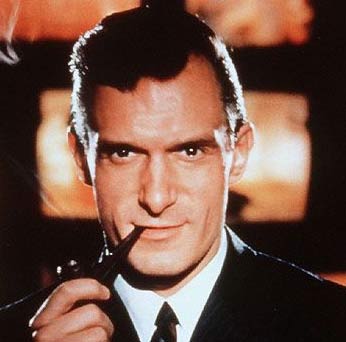
THE VERY SINGLE - AND SINGULAR - HUGH HEFNER

It is always astounding to me how a cultural icon’s most important works are overshadowed by fluff. Exhibit A: Hugh Hefner. Hefner, 85, has been a part of the American consciousness since the mid-20th century, when he quit his job at Esquire Magazine, scraped up a few hundred bucks from anybody who would help him, and quietly plotted the debut of “Stag Party,” a new world men’s magazine. Stag Party ran into licensing problems since there was already a magazine called “Stag,” and ended up being renamed “Playboy.” The very first issue featured a totally nude Marilyn Monroe (see cover below, left). The rest, as they say...

If you don’t dig too deep, all you find in Hefner is the above-mentioned fluff. Top heavy young girls, extravagant living, seemingly non-stop parties and lots of debauchery. That is why last week’s sudden exit of his would be 25-year-old bride made headlines worldwide. The China Economic Net proclaimed Hefner “dumped at the altar.” In the UK, the Independent declared, “Bad Luck, Hef – the Bunny’s Hopped it.” The New Zealand Herald ran a picture of the couple with the simple headline, “Cancelled.” Whatever Hefner does or does not do is big news in all corners of the earth, even a doomed marriage.

Who cares, right? Right. There is, however, so much more to care about when it comes to Hugh Hefner. What many people may not know is that Hefner has been what I would call a human rights and civil rights activist as long as he has been a publisher. His good works and good words have often been lost to his socially questionable lifestyle. That’s too bad, because those good works and words have changed the world.

Did you know (or remember) he used to have a TV show called “Playboy's Penthouse?” It ran for three years from 1959 – 1961. The camera would get a tight shot of elevator buttons lighting up one by one until it reached the penthouse apartment. Then the doors would open and viewers would see a party going on, people dancing, laughing, drinking, smoking. But here’s the rub: Some of the people were black, at a time when it was virtually unheard of for a TV show to feature anybody black, unless they were Amos and Andy. Bigger still was the fact that the show featured black performers, doing their thing with white performers. Unheard of. Sounds pretty tame now, but be aware that some of those black performers and party guests would probably not have even been allowed into buildings like the one portrayed in “Playboy Penthouse” in 1959. A white female folk singer performing with two black guys? Outrageous for its time.

Hefner’s “girlie” magazine and cool TV show (that could be considered the world’s first reality show) were really his vehicle to advance his agenda. The agenda had everything to do with freedom of speech and basic American liberty. Listen as he welcomes controversial comedian Lenny Bruce to “Playboy’s Penthouse.” Looks like fun, smooth and easy, but the conversation takes decidedly issues-oriented turns to censorship, racial integration and more:

This is one of only six network TV appearances Bruce ever made. American media was afraid of the Bruce’s often acerbic and envelope-pushing humor. So afraid was America of Bruce’s stretching the limits of the First Amendment that he was arrested multiple times, banned from many performance venues and even barred from certain U.S. cities. But Hefner, recognizing the underlying theme of freedom of expression, never wavered in his support of Bruce’s career. You don’t necessarily have to approve of Bruce’s material, nor of Hefner’s, for that matter, but the indisputable fact is that Hefner advanced the cause of freedom in America.

In 1973, when the movie Carnal Knowledge was deemed obscene by several state Supreme Courts, Hefner was interviewed in his own magazine on the 20th anniversary of Playboy. His fervent dedication to free speech was never more clearly evident: “What it amounts to is that the Nixon Court, which is supposed to be loaded with what he calls “strict constructionists” of the Constitution, has ruled that the First Amendment’s absolute protection of free speech and press doesn’t really mean what it says, that certain kinds of speech and writing aren’t necessarily free at all—speech and writing that has to do with sex. The Court has decreed that the ruling elite of every local community has the power to determine what everyone else in town may read or see.”

Anyone who doubts Hefner’s dedication to the absolute nature of freedom of expression should read “The Playboy Philosophy,” a 25-part Hefner-penned series that appeared in the magazine from 1962 – 1966. In it, Hefner clearly explained his beliefs about social and moral issues, right on the cusp of the American sexual revolution that took off in the late 1960s. Having just returned from London where he opened a Playboy Club, Hefner had witnessed the European sexual revolution firsthand, and saw it as much as an issue of human freedom as he did a sexual/cultural shift. The philosophy extended itself to issues like freedom of (and from) religion, as well as the critical importance of the separation of church and state.

In the 1960s Hefner befriended Jesse Jackson (below, left) and Dr. Martin Luther King. In fact, MLK was interviewed for the magazine by none other than Alex Haley (who later wrote “Roots”), who happened to be the writer who did the first interview the magazine ever featured. Hefner was passionate about civil rights and racial equality and integration. It has been a theme of his life, throughout his life. That’s where the fluff can really get in the way of the substance. The substance of Hugh Hefner is all about fairness, freedom and individual rights. It may be couched in lush photos of bare breasts and salacious cartoons, but if you really take time to study the history of his publication, it’s about you and me and what we deserve in a country that was built on a foundation of personal liberty. One could say that Hefner also advanced a culture that was steeped in puritanical repression to the next level of honest sexual expression. What’s not to like about that?

And so that brings us full circle back to one Crystal Harris, the 25-year-old would-be bride whose cold feet sparked headlines from sea to shining sea. Here’s the truth: Crystal Harris doesn’t matter. She may matter to her mom and dad or somebody, but she does not matter in the larger scheme of things. What matters about Hefner is his undying, lifelong commitment to your human and civil rights. He has long been someone I admired, if only for his unwavering efforts to open minds and hearts. I mean you have to love a guy whose left brain says, “Playboy was founded on the notion that nice girls like sex too,” while the other side says, “I urge one and all to live this life as if there is no reward in the afterlife, and do it in a moral way that makes it better for you and for those around you and leaves this world a little better place than when you found it."

Thursday, June 16, 2011

WHY TRACY MORGAN NEEDS A ONE WAY TICKET TO CAMBODIA

How interesting that suddenly, Tracy Morgan, a sort of second-string comedian, is all over the headlines. Oh no, it’s not because of his middling performance as alter-ego Tracy Jordan on the NBC sitcom “30 Rock.” It’s all about his throwback standup comedy act, which hit a wall in Nashville recently after he reportedly “joked” that he would “pull out a knife and stab that little nigger” if he found out his son was gay. It turns out an audience member was so taken aback by Morgan’s inane rant that he posted a piece about the Morgan show on Facebook. As is our cultural way here in 2011, the piece went viral, got picked up by national media and a firestorm ensued, causing Morgan to come forward to say how much he loves everybody. Right. Then comes news that Morgan is going to do some kind of something with GLAAD to show how much he really, really loves everybody. Right.

The upshot of all of this is a national discussion that is flooding the blogosphere, the airwaves and even good old print journalism about the extent of comedic license available to standup comedians. How much is too much? Is too much an oxymoron when you talk of standup routines? Is this a first amendment issue or rather a common decency issue? If you talk about your own son as a “little nigger,” is it hate speech or is it your divine right as a parent? When Morgan rants about stabbing his own son, is it funny or is it a desperate reach for a laugh when his audience has paid $86 a seat to laughs? And in a culture that decides to delete an Anthony Weiner from the public stage, why is it that a man who insults the gay population and the black population in one fell swoop is still front and center on one of the most highly-praised television shows on the air?

Whew! That’s a lot of questions, right? But doesn’t something like this merit a lot of questions? Didn’t we learn anything from the Michael Richards debacle back in 2006 at the Laugh Factory in Hollywood? That was the night Richards (below) got mad at some black hecklers in the audience and threw a temper tantrum in which he used the word “nigger” six times. Here’s how stuff like this works in our culture today: Richards, despite his very public apologies and mea culpa appearances on shows like Letterman, has had exactly four professional entertainment jobs since 2006, according to the Internet Movie Database (IMDB). Nobody is denying Richards his first amendment rights. But the American public has made it clear they can’t find much to laugh about when he speaks anymore. Once you do what Richards did, maybe you have to turn in your funny card and do exactly what he did next – retire from show business and take an extended trip to Cambodia. Really.

The issue here is not comedy. It is not Tracy Morgan. It is not how many people are offended. The issue here is respect. Comedians are divided on how to react to Morgan’s behavior. Some, like Louis C.K., came forward to say that Morgan was just “fucking around” and didn’t mean what he said. Said Louis, "Tracey Morgan said something wrong, evil, cruel, ignorant and hilarious. He was on a comedy stage, not at a pulpit.” Implicit in his remarks is the thought that since Morgan was on a comedy stage, respect for his fellow human beings is not required. Others, like Chris Rock (above, right), who initially defended Morgan’s right to say whatever he wants to say on stage, later came back with, “Wow, I get that shit wasn’t called for and I don’t support it at all.” And then there was Joan Rivers: “He’s lost his gay fan.” And, “I’ll tell you, the biggest crime of all is that Tracy Morgan isn’t funny. You know what he should be apologizing for? For charging $86 to see him.”

Indeed. But what no one seems to be addressing is the assumption among comedians that no matter what they say, who they hurt, how grotesque the images they put forth, they get a pass because it’s “comedy.” Here’s the thing: Comedy is cultural commentary. That’s really all it is. Comedians basically do the same thing that Rush Limbaugh, Chris Matthews, Rachel Maddow, Keith Olberman, Glen Beck and all the other talking cableheads do. They offer their take on the current state of our culture. As I see it, Morgan’s take on the current state of our culture is that gay people are somehow “less than,” and that probably they should be eliminated. And as I see it, Morgan somehow still believes there is a place in our national conversation for the word “nigger,” a stupid, throwback, throwaway word that we have been trying for decades to evolve out of the English language.

You know, besides the fact that Morgan appears to be somehow surviving this ridiculous tirade, with even his “30 Rock” boss, Tina Fey still somewhat reluctantly embracing him, (below, left) here’s what bugs me: The historic Ryman Auditorium in Nashville (which used to be the home of the Grand Ole Opry), where Morgan had his comedic tantrum, seats 2400 people. Let’s do the math: 2400 x $86.00 = $206,400. After paying the venue, the promoters, the tour expenses and his agent, manager, etc., let’s say Morgan gets 40% of the gross. That means that for denigrating millions of Americans in the name of comedy, Morgan earned upwards of $80 grand that night. And it gets worse: For those Americans who vaguely knew who Morgan was prior to the Nashville performance, now every American who has been conscious the last week or so knows who he is. You know the old, “I don’t care what they say about me, as long as they spell my name right” routine? My biggest concern here is that now Morgan is a household word whose ignorant cultural trespasses may imprint him on the American psyche as a “bad boy comic” who just said some stupid stuff once in Nashville. All that, and here I was hoping he'd go be Michael Richards' roommate in Cambodia.

So, in the end, does it all simply mean that in America, saying you will cut up your “little nigger” kid with a knife if he says he’s gay is worth $80,000 and an ongoing national television career. How did we get here?

Wednesday, December 15, 2010

DANGER! CENSORSHIP AHEAD

Back in 2008, the United States Air Force quietly instituted a new rule banning troops from visiting any web site with the word “blog” in its URL. So, for example, if you enlisted in the Air Force, you would no longer be allowed to bring up www.GreenbergRants.blogspot.com on your computer. This was not highly publicized, but it was enforced. The Air Force published this statement at the time: "The idea isn’t to keep airmen in the dark — they can still access news sources that are primary, official-use sources. Basically … if it’s a place like The New York Times, an established, reputable media outlet, then it’s fairly cut and dry that that’s a good source, an authorized source.”

That changed this week when the Air Force revealed it has blocked 25 news and information sites from its troops. The purpose, it explains, is to make sure that troops do not have access to classified documents leaked by WikiLeaks. One of the sites blocked by the Air Force is none other than The New York Times. Somehow, between 2008 and yesterday, the New York Times is no longer deemed “an established, reputable media outlet.” So far, the Army and Navy have not followed suit. Foreseeing a possible PR fallout, the Department of Defense (DOD) was quick to issue a statement that makes it clear this was not ordered from the DOD. Access to the 25 sites is denied on all official Air Force computers, which means troops can still access anything they want to see on their home computers, but they are reportedly being discouraged from doing so.

So, what’s going on here? One could conjure thoughts of censorship, right? Right. The Air Force has made a largely symbolic move which only furthers its image as an operation that seeks to control the flow of information to American citizens. Those citizens happen to be the very ones who voluntarily signed up to serve their country – a country that thrives on its First Amendment rights. Where’s the logic? I agree with CNN’s legal analyst, Jeffrey Tubin, who responded to the news this way: "This seems like a rather pointless protest. Our enemies can see the documents, but not those whom we trust to defend our country."

The predictable outcome here is a wave of resentment among enlisted personnel, and under-informed masses of troops. The last thing we need is to have our own U.S. military not be allowed to access news and information about the very country they defend. As of today, the Air Force has not even released a full list of the 25 sites it has blocked. We do know that the New York Times is the only U.S. newspaper on the list. Will some activist enlistees go to court based on a denial of the First Amendment rights? Will the complex Freedom of Information Act be cited in protest to the ban? Too soon to tell, but I trust there are bright, thoughtful people in the enlisted ranks who will not take this lightly.

Meanwhile, in a related story, one of the incoming Congressional Tea Party-elects. Allen West (R-FL) is calling for American news companies to be censored for running stories based on the recent WikiLeaks cable dump. He refers to the publishing of information about the whole WikiLeaks debacle as “aiding and abetting of a serious crime.” Listen to what West had to say:

Let’s review: Here is the key part of the First Amendment to the United States Constitution that West seems unfamiliar with: “Congress shall make no law respecting an establishment of religion, or prohibiting the free exercise thereof; or abridging the freedom of speech, or of the press.” I rest my case. Note to Mr. West: In the unlikely event that news organizations were to be censored, have you given thought to who would decide what can and cannot be reported, and who would set these standards? I think not. And even if you could somehow circumvent the First Amendment, who are you to decide what information is inappropriate for me?

In defending the Times’ decision to run the WikiLeaks information, Public Editor Arthur Brisbane wrote this on December 5:
“What if The New York Times in 1964 had possessed a document showing that L.B.J.’s intent to strike against North Vietnam after the Gulf of Tonkin incident was based on false information? Should it have published the material?
What if The Times had possessed documentary evidence showing that the Bush administration’s claims about Saddam Hussein’s weapons of mass destruction were unfounded? Should it have published the material?”
When government officials or military organizations start making noises about limiting the free flow of information, everybody loses. They lose respect and credibility because they are then perceived as practicing censorship. Citizens lose their most vital links to information that directly affects their lives. The U.S. loses the respect of other world powers because suddenly everything our country was built on is being compromised.

Brisbane summed it up best: “The Times, like other serious news organizations in democracies, exists to ferret out and publish information — most especially information that government, business and other power centers prefer to conceal. Arming readers with knowledge is what it’s about, and journalists are motivated to pursue that end.”

Thursday, January 21, 2010

THE SUPREMES JUST CHANGED THE GAME

Politics, big business, money and high technology. Now there is a recipe for power, right? Chew on that for a moment while we explore what happened in the Supreme Court this week.

The Justices this week amended a six decade old law that limits the amount of money that corporations or labor unions can contribute to a political candidate’s campaign. Until now, there were severe restrictions on such donations, particularly since 2002 when the Bipartisan Campaign Reform Act (more commonly referred to as McCain-Feingold) was enacted. This week, the Supreme Court essentially negated McCain-Feingold, and opened the door to a new era in which corporations and labor unions can spend as much of their organizational funds as they wish to ensure that “their” candidate is elected.

So what? Well, critics of the decision to reverse McCain-Feingold say this will severely inhibit the electoral process. Big business and labor will elect the President, while the common man, if you will, will have even less power and influence on perhaps the most important decision the citizenry makes.

The decision is the result of a suit brought by Citizens United, an conservative group that produced a film called “Hillary The Movie” during the 2008 campaign. The anti-Hillary film was shut down after a federal court ruled that the showing of this film violated the McCain-Feingold act. Because it was paid for by corporations in the 30 days before a presidential primary and in the 60 days before the general election, the court ruled it was in direct violation. Here is the trailer from the movie:

Supporters of the Supreme Court decision are leaning heavily on the First Amendment to the Constitution, somehow connecting the right of free speech with the right to spend massive amounts of money to ensure that a message is conveyed to the public. That is the sticking point in my mind. Since when is the amount of money someone spends to convey an idea commensurate with how much freedom he or she has to say it?

The Court was split 5-4 on this. Justice Anthony Kennedy, speaking for the majority opinion, said, "Because speech is an essential mechanism of democracy -- it is the means to hold officials accountable to the people. Political speech must prevail against laws that would suppress it by design or inadvertence.”

The great irony here is that this grassroots, non-profit organization, Citizens United, managed to open the doors for the biggest profit-making corporations in the world to spend astronomical amounts of cash to elect politicians that will favor their commercial agendas.

Something tells me when the founding fathers drafted the Constitution, they were not associating the amount of money someone had with the freedom that they had to speak up. It is the current Supreme Court that has now made that assertion, and it seems quite twisted. And how timely: For years then, according to the Court, America has been denying corporate America its right to express itself. It just so happens that right as corporations get to spend as much as they want to promote a candidate, technology is simultaneously sophisticated enough to spread their message to a wider audience in real time. In terms of the potential for special interest groups to sway an election, I'd call this moment a perfect storm.

President Obama is not pleased. Shortly after the decision was rendered, Obama said, "With its ruling today, the Supreme Court has given a green light to a new stampede of special interest money in our politics. It is a major victory for big oil, Wall Street banks, health insurance companies and the other powerful interests that marshal their power every day in Washington to drown out the voices of everyday Americans.”

With that he immediately issued a directive to Congress to start hashing this whole thing out in a bipartisan fashion and to push back against the Court’s decision. The trouble is that legal experts say there is not a whole lot Congress can do to counter the Supreme Court.

Talk radio is having a field day with this development. On Thursday, Rush Limbaugh pronounced Obama an “idiot who just happens to be President.” When Senator Chuck Schumer (D-NY) said the Court’s decision “undermines Democracy” and taints the electoral process, Fox's Sean Hannity used his airtime to launch personal attacks on Schumer, rather than to counter the Senator’s claims with a reasonable defense of the decision. Here is what Schumer said after the decision was handed down:

Visit msnbc.com for breaking news, world news, and news about the economy

Here is why this matters to you. For example, if the oil industry spends millions of dollars during a Presidential campaign, and its favored candidate wins, clearly the industry will have great persuasive power in Washington for the next four to eight years. That power easily can lead to legislation that favors the industry at the expense of your bank account. If the auto industry pushes its chosen candidate through, is it not possible it would use its newfound clout to see that certain safety or environmentally friendly features on cars may be eliminated, since the industry would prefer to spend less money manufacturing its vehicles?

And what about the airline industry? Currently in complete disarray, without even a person at the helm of the Transportation Safety Administration, what if it manages to maneuver a candidate into office? Will air marshals on domestic and international flights be eliminated to save money? Will airport security personnel be pared down to limit expenses? Will airlines manage to continue flying certain planes well after they should have been retired?

The Supreme Court’s decision is all about you. Everything that occurs in the upcoming elections this year and in 2012 is now likely to be highly influenced by corporate dollars and less influenced by you. The activity that occurs in an administration created by big business is likely to work against you, rather than for you. This brings us back to the strange bedfellows of politics, big business, money and high technology. Where do you and I fit in there? I can’t see that we do.
(Read the entire Supreme Court opinion on Citizens United v. Federal Election Commission here)

Wednesday, August 19, 2009

AMERICANS BEHAVING BADLY -- BECAUSE THEY CAN

We’ve seen some really bad behavior lately among Americans in town hall meetings. Ostensibly, the conflict among Americans right now is the future of healthcare in America. These very public displays of anger and frustration could just be born of something much more than the current healthcare debate. Something tells me people would not be carrying signs with swastikas on them, and defacing pictures of President Obama to make him look like Hitler, if something deeper wasn’t happening here.

For eight years, under George W. Bush, the nation was highly repressed. The Bush White House was inarguably one of the cagiest, most secretive administrations in recent history. Americans shed themselves of what little trust they had left in government. The trust erosion really began with the Nixon administration. People in my generation watched the whole Watergate debacle at the tail end of the Vietnam era. We saw how truly untrustworthy government can be. To many of us in this age bracket (50s), every President we have had since then has been a letdown. That means that a new President has to not only live up to our expectations, but he has to prove that he’s got the stuff with which to do it.

Along comes Barack Obama, who still seems to be a really decent guy. But he showed up as economic prosperity was in the past. Every time a recession happens, there is a substantial part of the population that circles the conservative wagons in a defensive posture. That’s what Obama walked into – a tightly closed set of American conservatives. This is not a political statement. It is, rather, simple observation of what has happened since last November. A black, liberal President walked through the gates of a racially skeptical electorate, at a time when public dissatisfaction with the Presidency was at its absolute hottest.

So, when I see people blatantly strapping guns onto their backs outside of a hall where the President is scheduled to speak, that’s not about healthcare. It’s about anger. It is about stretching the First Amendment beyond its borders. When I watch a woman repeatedly yell, “Heil Hitler” to a Jewish guy at a Town hall meeting, it is not just about about healthcare. It is absolutely about exasperation and disgust with government. I believe the natives are restless – so restless that they are turning on each other. Americans and their legislators are facing off in public, and it’s not pretty. Both are conducting themselves in ways they would never have pictured themselves behaving. On television. Watch:


Yes, healthcare is a critical issue, and yes it is the catalyst for all the yelling and acting out we are witnessing in these town hall showdowns. But healthcare is simply the soapbox. Those who are aggressively acting up -- armed with megaphones and decades-old frustration, jobless and frightened—those people are not just there to protest potential health insurance laws. They are there to say that enough is enough. The people in this country were marginalized for eight years, while despotic and ill-equipped leaders guided us into failed banks, corporate chaos, the highest unemployment rate in 26 years, and an international reputation best described as global disdain. America is damned mad. And it is speaking up in record numbers and in ways it hasn’t allowed itself to be heard since Vietnam.

I’m with Barney Frank. Indeed what is unfolding here is a true testament to the First Amendment to the U.S. Constitution. I would like to see the loudest among the protesters get their point across without being so disrespectful toward their opponents. Honestly, I’d like to see a little more decorum here. Sometimes it is easier to hear what someone is trying to say when they stop screaming, brandishing semi-automatic weapons and comparing our nation to Nazi Germany. Still, I support their right to do it. Here’s why: “Congress shall make no law respecting an establishment of religion, or prohibiting the free exercise thereof; or abridging the freedom of speech, or of the press; or the right of the people peaceably to assemble, and to petition the Government for a redress of grievances.” That is the entire First Amendement text. Read it again. Haven’t we lost enough freedoms in this country already? We can’t risk losing this one. If only I were able to be as eloquent about this as these guys: